
Identification Guide for Cat Serial Number Prefixes
Posted by Broken Tractor on Jul 7th 2026
The model decal on a Cat backhoe, dozer, or excavator tells you surprisingly little. The three characters at the front of the serial number tell you almost everything — which generation, which configuration, and which parts book your machine lives in. Here's how to read them, where to find them, and how to use them to order the right parts the first time.
Call a parts supplier and say “I've got a Cat 416” and the first question back will be: what's the serial number prefix? That's not the counter being difficult. Caterpillar built four distinct generations of machine that all say “416” on the arm, and they share almost nothing. The thing that separates them — the thing Cat's own parts system is organized around — is the three-character code at the front of the serial number: 5PC, 8ZK, 1WR, BGJ.
This guide explains how Cat serial numbers work on both the old 8-character plates and the modern 17-character PIN plates, what the prefix does and doesn't tell you, where to find the plate on backhoes, dozers, and excavators, and why all of it decides which parts fit your machine. There's a quick-reference prefix table near the end covering the Cat machines we get the most calls about.
What's in this guide
- How a Cat serial number is built
- The modern 17-character PIN (2001 and up)
- What the prefix actually tells you
- Same decal, different machine: why prefixes exist
- Serial breaks: when parts change inside one prefix
- The other plates: engine, transmission, and attachment serials
- What about the year?
- Where to find the plate on your machine
- Quick-reference: Cat prefixes by machine
- Ordering parts with the prefix in hand
How a Cat serial number is built
For most of the machines in our customers' yards, a Cat serial number is 8 characters: a 3-character alphanumeric prefix followed by a 5-digit sequence number. So a serial like 5PC06192 breaks down as prefix 5PC (a Cat 416 backhoe) and unit 06192 off that line.
Go back far enough and the prefixes get shorter. Cat's antique iron used 2-character prefixes — a 1950s D4 is a 6U (narrow gauge) or 7U (wide gauge), a D6 of the same era is an 8U (60″ gauge) or 9U (74″ gauge). Notice what Cat was doing even then: same model, different prefix, different physical configuration. As the model lineup exploded, Cat ran out of two-character combinations and moved to three.
The zero-padding trick — Older plates often show the sequence without leading zeros: a D6D plate might read 4X2592. Cat's systems want 8 characters, so short numbers get padded with zeros: 4X2592 becomes 04X02592. If a parts lookup rejects your serial number, this is usually why.
The modern 17-character PIN (2001 and up)
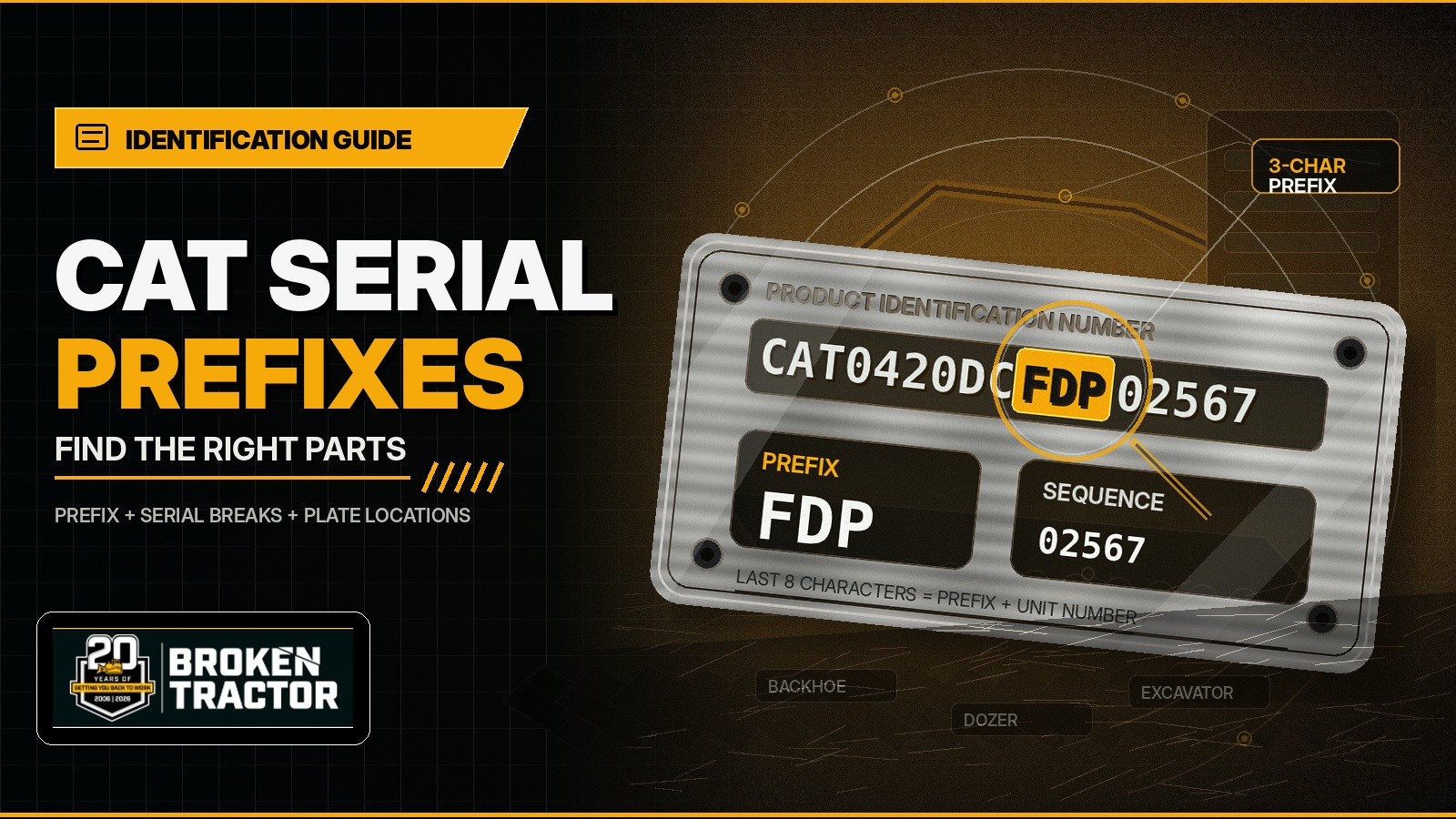
From 2001, Cat machine plates carry a 17-character Product Identification Number under the ISO 10261 standard. It looks intimidating — CAT0420DCFDP02567 — but it decodes in four pieces:
| Characters | What they are | In CAT0420DCFDP02567 |
|---|---|---|
| 1–3 | Manufacturer code | CAT |
| 4–8 | Model, zero-padded to 5 characters | 0420D (a 420D backhoe) |
| 9 | Check character — assigned by Cat to deter counterfeit plates | C |
| 10–17 | The 8-character serial number: prefix + sequence | FDP02567 |
The part that matters is the last 8 characters. Everything a parts counter needs — ours or the Cat dealer's — lives in positions 10 through 17. The old-style serial number didn't go away in 2001; it just moved to the back of a longer string. Read the PIN off the plate, keep the whole thing in your phone, but know that FDP02567 is the working ID of that machine.
What the prefix actually tells you
A Cat prefix identifies three things: the model, the configuration, and the factory that built the machine. The configuration part is what surprises people, and it's best shown with a real example. The D6C dozer — one model, one decal — shipped under at least four prefixes:
- 10K — D6C, powershift
- 69U — D6C LGP
- 99J — D6C
- 17R — D6C, special application
The D6D did the same thing: 04X is a powershift machine, 03X is direct drive, 06X is the LGP powershift. And on the small dozers Cat kept the pattern right into the modern era — the G-series machines got one prefix per configuration pair: D3G XL and LGP are BYR and JMH, D4G are HYD and TLX, D5G are RKG and WGB.
Why you should care — Powershift vs. direct drive is a different transmission. LGP vs. XL is a different undercarriage. When a listing or a parts book is keyed to a prefix, it's really keyed to those mechanical differences. It's why our track adjuster yoke for D6K and D6K2 dozers (382-6529) lists its fitment as a string of prefixes — DHA, FBH, RST, WMR, MXK, RPR — instead of just “D6K.” That's the honest way to state fitment on a Cat machine.
Two things the prefix does not tell you: the year (see section 7) and, on some models, the full story — which is where serial breaks come in (section 5).
Same decal, different machine: why prefixes exist
Here are the three families where prefix confusion costs our customers the most money.
The 416 backhoe family. Between the mid-1980s and the 2000s, Cat built the 416 (5PC), the 416B (8ZK, 8SG), the 416C (1WR, 1XR, 4ZN, 5YN), and the 416D (BGJ). Four generations, seven-plus prefixes, separate parts books — different engines, different hydraulics, different sheet metal. A radiator for a 416B (4P3379) is not a 416C radiator, and a dipper cylinder (109-7020) fits the machines on its list because of what's under the paint, not the number on the decal. When a customer tells us “416” plus the prefix, the guesswork is over.
D6K vs. D6K2. The D6K carried prefixes like DHA and FBH (FBH is the XL); the D6K2 that replaced it runs RST and JTR (LGP), WMR (XL), MXK, and RPR. Some parts carry across — our track adjuster and recoil spring assembly (239-8247) fits both the D6K and D6K2 — but never assume it. Check the listing's prefix coverage or ask.
E200B to 320: the lineage trap. Cat's E200B/EL200B excavators (built in the Cat-Mitsubishi era under prefixes 6KF, 6KG, 4SG, 7DF) were replaced in the 1990s by the first 320 family (9KK for the 320L, 9WG for the 320N). The machines look related, and some components did carry over — our recoil and track adjuster assembly (7Y1602) fits the 320, 320L, E200B, and EL200B — but plenty didn't. The prefix tells you which side of the changeover you're on.
Serial breaks: when parts change inside one prefix
Knowing the prefix narrows you to the right parts book. The full serial number matters because Cat changed parts mid-production without changing the prefix. Parts books split their coverage at specific unit numbers — the “serial break” — and real examples look like this:
- Cat 416 (5PC): books split at 5PC00001–06191, 5PC06192–10761, and 5PC10762-up — that last break is where the 416 Series II begins. Same prefix, three coverage windows.
- Cat 416B (8ZK): splits at 8ZK06000. Its sister prefix 8SG splits at 8SG12000.
- Cat 420D (FDP): three windows — FDP00001–07198, FDP07199–18399, FDP18400-up.
- Cat 426 (7BC): the Series II changeover lands at 7BC03477.
- Cat 320L (9KK): splits at 9KK01359.
Aftermarket listings inherit these breaks. Our track tensioner assembly for Cat 311C, 312C, and 314C excavators (168-6684) literally carries “after serial ranges” in its fitment — on the wrong side of the break, that machine takes a different tensioner. This is why the answer to “will it fit my 420D?” is sometimes another question: what's the whole serial number?
The other plates: engine, transmission, and attachment serials
One machine, several serial numbers. Cat parts books for a single dozer routinely cover multiple serial systems at once — the D5K XL/LGP book, for example, covers machine prefixes JLF, WWW, and YYY, plus C4E engine serials, JMJ ripper serials, and JAG winch serials. Backhoes are the same story: a Cat 438 in the field carries a machine plate, an engine plate, and a transmission serial — three different numbers, none interchangeable.
The rule of thumb — Machine parts (undercarriage, cylinders, sheet metal, seats, brakes) go by the machine serial. Engine parts go by the engine serial, which has its own prefix on its own plate. If the block was ever swapped — common on fifty-year-old iron — the engine serial won't match what the machine shipped with, so read it off the engine, not the paperwork.
Attachments count too — Rippers, winches, and backhoe attachments have their own plates. If you're ordering for the hoe end of an older machine, check the attachment plate before assuming the machine serial covers it.
What about the year?
Here's the one everybody gets wrong: neither the prefix nor the PIN encodes the model year. Car VINs carry a year character; Cat machine PINs, as Cat implemented them, do not — the last eight characters are the prefix and sequence, period. Cat knows the build date of every unit, but that lives in Cat's internal serial records, not on the plate.
To get the year: call any Cat dealer parts counter with the prefix and serial — they can pull the build date for free. For antique machines (pre-1960s), the Antique Caterpillar Machinery Owners Club (ACMOC) publishes serial number references and its forum answers year-lookup questions daily. Paid services like EquipmentWatch also verify year by serial. Be skeptical of any listing that states a year with confidence but no source — used equipment changes hands with paperwork that drifts, and the “2004” machine you bought may be a 1999 with a repaint.
Where to find the plate on your machine
Backhoe loaders — On the 416 series, the plate sits on the right side of the machine just above the base of the cylinder arm, with the full number stamped into the frame below it. On the other models (420 through 450), look on the left side in the same spot — and the 420 series repeats the stamped number on the right side. We covered plate locations across brands in Where Is the Backhoe Serial Number?
Dozers — On machines up to D4 size, check the left side of the engine compartment near the cab. On a D5K, the plate is under the cab above the rear of the left track. On larger machines it moves to the rear, high on the end of the left frame rail — and if a ripper is mounted, it's often hiding behind it.
Excavators — Right side exterior of the cab, below the window. Pre-1990 machines may carry a second plate inside the cab — left of the seat inside the door, or down by the operator's right foot. The old 215/225/235 machines put a plate on the boom above the ladder.
Plate missing or painted over? Cat stamped serial numbers into the steel, not just onto plates. On big dozers, check the back of the main frame on the left side (again, behind the ripper). Wire-brush carefully, photograph what you find, and keep the photo with the machine's records. One caution from the used-iron world: a serial number that's been deliberately ground off is a stolen-machine red flag — walk away.
Quick-reference: Cat prefixes by machine
Every prefix below is verified against factory parts and service book coverage. This isn't every prefix Cat ever issued for these models — it's the ones we see most on machines our customers run. If yours isn't here, the plate is still right and we can still look it up.
Backhoe loaders
| Prefix | Machine | Worth knowing |
|---|---|---|
| 5PC | 416 | Series II begins at 5PC10762 |
| 8ZK, 8SG | 416B | Breaks at 8ZK06000 and 8SG12000 |
| 1WR, 1XR, 4ZN, 5YN | 416C | Four prefixes, one generation |
| BGJ | 416D | |
| FDP, BLN | 420D | FDP breaks at 07199 and 18400 |
| 7BC | 426 | Series II begins at 7BC03477 |
| 7WN | 426C |
Dozers
| Prefix | Machine | Worth knowing |
|---|---|---|
| 10K, 69U, 99J, 17R | D6C | Powershift / LGP / standard / special application |
| 03X, 04X, 06X | D6D | Direct drive / powershift / LGP powershift |
| 3MK, 5HS, 8ZS | D5C, D5C III, D5C III LGP–XL | |
| BYR, JMH | D3G XL, D3G LGP | One prefix per configuration |
| HYD, TLX | D4G XL, D4G LGP | |
| RKG, WGB | D5G XL, D5G LGP | |
| JLF, WWW, YYY | D5K XL/LGP | Engine = C4E, ripper = JMJ, winch = JAG |
| DHA, FBH | D6K | FBH is the XL |
| RST, JTR, WMR, MXK, RPR | D6K2 | RST/JTR = LGP, WMR = XL |
| 6U, 7U | D4 (1947–59) | Narrow / wide gauge |
| 8U, 9U | D6 (1947–59) | 60″ / 74″ gauge |
Excavators
| Prefix | Machine | Worth knowing |
|---|---|---|
| 6KF, 6KG, 4SG, 7DF | E200B / EL200B | Cat-Mitsubishi era |
| 9KK | 320L (first generation) | Break at 9KK01359 |
| 9WG | 320N | |
| AMC | 320C L | |
| 4YM, 6YM | 315 / 315L | |
| CFB, CJC | 315C L | |
| CJN | 315D L |
Ordering parts with the prefix in hand
When you contact us (or anyone) about Cat parts, here's the information that gets you the right part on the first try:
- Model and full serial number — the whole 8 characters, or the whole 17-character PIN. Not just “a 420D” — “a 420D, FDP07421.”
- Engine serial, if the part is engine-related — off the engine plate itself.
- Attachment serial, if you're ordering for a ripper, winch, or hoe on an older machine.
- Photos of the part on the machine, if anything about the fitment feels uncertain. A picture settles prefix ambiguity fast.
Where the common Cat parts live in our catalog, by machine type:
Backhoes — Cat backhoe parts, including brakes (like the brake assembly 230-3809 for 420E/428D/430E-class machines), hydraulic cylinders (the 430D dipper cylinder 205-8656, the stabilizer/outrigger cylinder 116-4365), stabilizer pads (the 9R-5555 pad for 416D/420D/430D and the double-duty rubber pad 237-9356), and seats (suspension seat with pedestal C470331-CAT, steel-pan suspension seat C330331-CAT).
Dozers — Cat dozer parts, including undercarriage, track adjusters and recoil springs (the D3C/D4C adjuster and recoil kit PV339, spring assembly PV345 for D3C/D3G/D4C/D4G, D5C/D5G spring assembly PV343, and the adjuster yoke 6S7399), brush screens (the side screen set 250-1699 and the PV6009 screen set for D3K2/D4K2/D5K2 and next-gen D1–D3), plus G/K-series blade hardware like the blade ball pivot kit PV5009 and the D4H XL/LGP blade angle cylinder kit.
Excavators — Cat excavator parts, including track adjusters and recoil springs (the 315-family recoil and adjuster assembly 130-9332, the 324D/326FL recoil spring assembly 239-4418, and the 297-9142 recoil and adjuster assembly), final drives, hydraulic cylinders (like the bucket cylinder 118-3934 for the big 345B/385B frames), and sheet metal.
And if the machine predates the letter series entirely, start at the main Caterpillar parts category — we support machines Cat stopped building decades ago.
Have your prefix? Let's find your parts.
Track adjusters, cylinders, brakes, seats, screens, and undercarriage for Cat backhoes, dozers, and excavators — fitment stated by serial number prefix wherever Cat drew the line, and shipped from U.S. warehouses. Send us the model, the full serial number, and what you need, and we'll confirm fitment before it ships.
Broken Tractor Editorial Team
Broken Tractor LLC stocks aftermarket parts for Caterpillar backhoe loaders, crawler dozers, excavators, and telehandlers — from E-series and 5PC-era machines through current production. Prefix and serial-break references in this article are drawn from Caterpillar parts and service publication coverage; always confirm against your machine's plate before ordering.
Keep reading
- Identification — Where Is the Backhoe Serial Number?
- Serial Number Guide — Case 580 Series Loader Backhoe Serial Number Guide
- How-To — How to Measure Track Gauge on Dozers and Excavators
- Cat Parts — Caterpillar Dozer Parts at Broken Tractor