
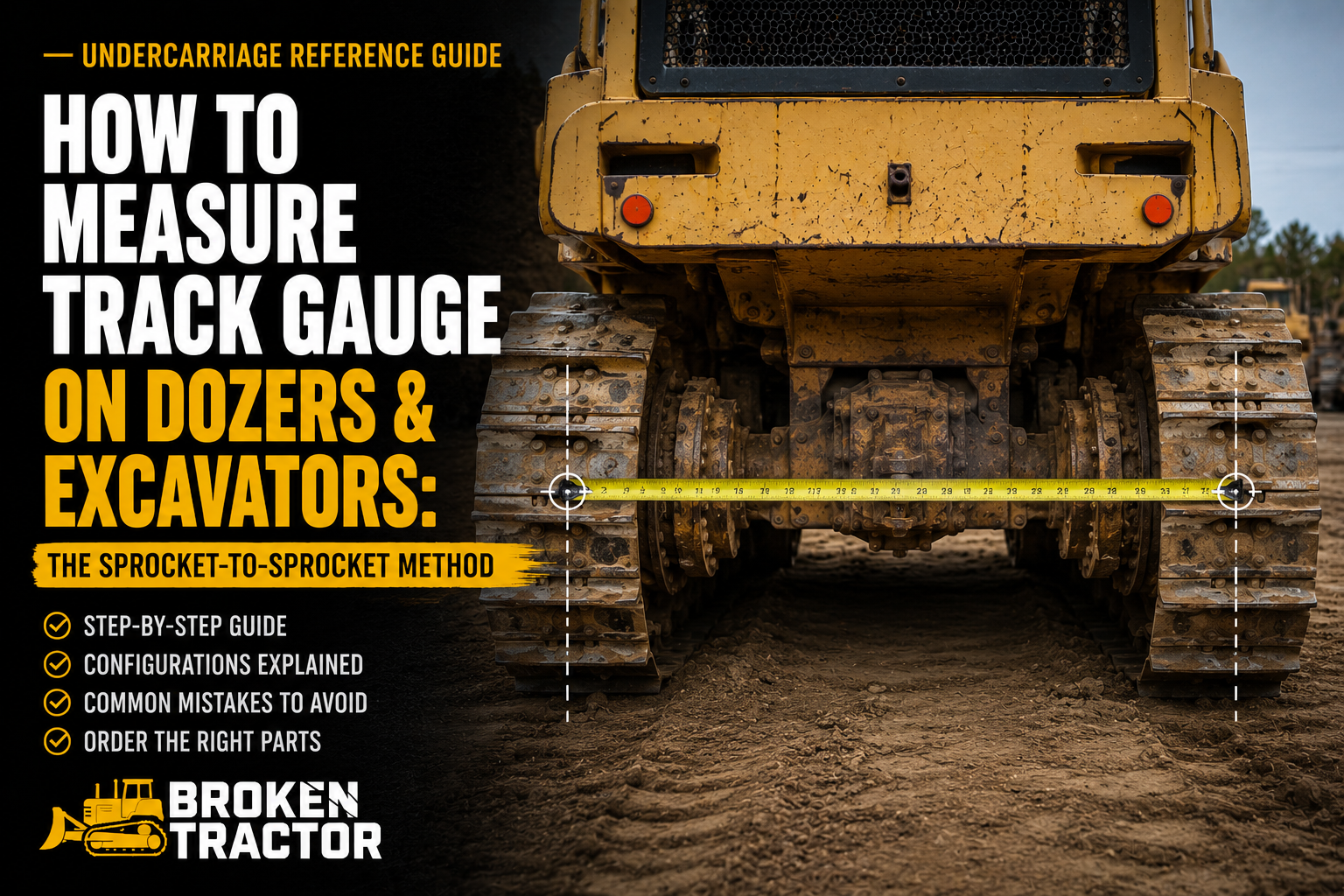
How to Measure Track Gauge on Dozers and Excavators: The Sprocket-to-Sprocket Method
Posted by Broken Tractor on May 19th 2026
Track gauge isn't just a measurement — it's the spec that decides which undercarriage configuration your machine actually has. Two Cat D6Cs can sit in the same yard with a nine-inch difference in gauge and need completely different track shoes, chains, rollers, and recoil springs. Here's how to measure it right and use the number to order parts that actually fit. Pull up to the back of a dozer with a tape measure and most operators can tell you the pad width on the track shoes without thinking. Ask them the gauge and you'll usually get a pause. That pause is what costs people money when they order undercarriage parts. Track gauge is the spec that tells you which configuration the undercarriage is — and most production crawlers were built in more than one. A standard Cat D6C runs a 74-inch gauge. The LGP version of the same machine is 83 inches — the track frames spread nine inches farther apart to carry the wider pads. The two machines look almost identical from across the yard. They take different track shoes, different chains, different roller spacing, different blade widths, and in some cases different recoil springs. The whole pile of "almost fit" parts in every parts department on earth started with somebody assuming gauge from the model number. This guide covers what track gauge actually is, the three things people mix it up with, how to measure it in two minutes with nothing more than a tape measure, and how to use the number to order the right undercarriage parts the first time. It works for dozers, excavators, and compact track loaders alike — with one extra wrinkle for mini excavators with retractable undercarriages, covered at the end. When someone says "track width" on a crawler, they could mean three completely different things — and the right answer depends on the part you're trying to order: These three numbers all relate, but they aren't interchangeable. You can have two machines with the same overall width but different gauges (one with a wider gauge and narrower pads, one with narrower gauge and wider pads). You can also have two machines with the same gauge running entirely different shoe widths. Production crawlers are typically built in two to four undercarriage configurations from the factory. Same model number on the side, different gauge underneath, different parts under that. The configurations let manufacturers offer the same machine for different ground conditions — a narrower-gauge build for hard ground and rocky work, a wider-gauge build for soft soil and flotation. The Cat D6C is the textbook example. From the factory it came in two distinct gauges: That nine-inch difference exists for one reason: the LGP build had to accommodate 30-inch wide pads where the standard build was running 18-inch pads. The wider pads spread the same machine weight over more ground contact area, which is the whole point of Low Ground Pressure — better flotation on soft ground, less rutting, lower psi at the soil. The track frames had to spread outward 4.5 inches per side just to make room for the wider shoes without them fouling the blade arms. Once the frames spread, the entire roller spacing changed, the chains changed, and the recoil tensioning geometry shifted. So even though the model badge says D6C on both, the parts catalog has two distinct undercarriage configurations underneath. Every major manufacturer does some version of this. Cat uses the configuration codes Standard, XL (Extended), XW (Extra Wide), and LGP. Komatsu has its own designations. Case dozers came in similar standard and LGP variants across the 450, 550, 650, 750, 850, 1150, and 1450 series. Without knowing the gauge, you can't tell which configuration is sitting in front of you — and you can't order the right parts. The easiest place to measure track gauge on a crawler is at the rear, sprocket-to-sprocket. Here's why this method works better than other approaches: This takes two minutes once the machine is parked safely. You need a tape measure and a piece of paper. Some configurations — particularly on John Deere high-track dozers and a handful of older Case machines — put the drive sprocket at the front and the idler at the rear. The method still works; just measure between whatever two drive sprockets you have, front or back. The key is using the sprocket face on both sides, not the idler, because the sprocket is the reference point that won't move as components wear. If your machine is a crawler dozer, the gauge measurement maps to one of a handful of factory configurations. The exact code varies by manufacturer, but the concept is consistent: Once you know the gauge measurement, you can match it to one of these configurations in your machine's service manual or by reaching out to our parts team. From there, ordering chains, shoes, rollers, idlers, recoil springs, and track adjusters becomes straightforward — you're ordering for a known configuration rather than guessing. Excavators use the same gauge concept, but with one important wrinkle on smaller machines: many mini excavators have retractable undercarriages, which means the gauge changes on demand. On standard excavators — including most mid-size and full-size machines from Cat, Komatsu, Hitachi, Volvo, Kobelco, Doosan, Hyundai, John Deere, and Case — the undercarriage is fixed. The sprocket-to-sprocket method works exactly the same as it does on a dozer. Measure, record, match to configuration, order parts. On full-size excavators, gauge variation usually comes in the form of standard vs. long undercarriage (sometimes called LC or long carriage). The longer carriage adds track length and roller count for stability in lifting work, while gauge itself may stay similar or change slightly depending on the model. Many mini excavators in the 1.5–3 ton class — including Bobcat E10, John Deere 17P/17G, Case CX17C, Hitachi ZX17U, Kubota smallest U-series, Cat 300 series mini-ex models, and most micro-excavators — have a hydraulically retractable undercarriage. The tracks pull in for transport (so the machine fits through a 36-inch residential gate) and extend back out on the jobsite for stability. For these machines, gauge isn't a single number — it's a range. The spec sheet typically lists both: When measuring gauge for parts on a retractable-undercarriage machine, always measure with the tracks fully extended. That's the operating configuration, and that's what the manufacturer's spec sheet number refers to. Measuring in the retracted position gives a different number that won't match any catalog spec. Once you know your gauge, you're ready to order the parts that depend on it. Most of these come in configuration-specific variants, and the part number will differ between, say, a standard-gauge dozer and an LGP version of the same model. The chain is the single biggest gauge-dependent purchase. Width, pitch, and overall length all change with configuration. Browse John Deere excavator steel track undercarriage, Case excavator steel track undercarriage, Komatsu steel tracks, Hitachi steel tracks, Kobelco excavator steel track undercarriage, JCB excavator steel tracks, Takeuchi excavator steel tracks, Yanmar excavator steel tracks, and Volvo excavator steel tracks. Shoe width is independent of gauge in spec, but configuration determines what widths can physically fit. Common widths in our catalog include 16-inch single grousers, 20-inch and 24-inch shoes for mid-frame dozers, and 28-, 30-, and 34-inch shoes for LGP machines. Available widths in stock: 10", 12", 14", 16", 18", 20", 22", 24", 28", 29", 30", and 34". Often overlooked when ordering new shoes — the bolt-and-nut hardware is matched to the chain and shoe combination. We stock kits like CR2084 bolt & nut kits for 20", 22", and 24" pads and series-specific kits for Case 450, 550, 650, 750, 850, and 1150 dozers. Our top-selling track-pad bolt last year moved 1,299 units — order the right hardware with the shoes. The tensioning hardware is configuration-specific because the spring geometry changes with gauge. Recoil springs and adjusters by series: Wear plates, track guards, and frame protection are configuration-specific. The Case 1150 dozer track wear parts and Case 1150 dozer track guards categories show how series-specific these get. Series-specific Case dozer track parts: 310, 350 & 350B, 450 series, 550 series, 650 series, 750H, 750K & 750L, 850 & 855, and 1150 & 1155 series. For full undercarriage rebuilds and replacement assemblies: Case dozer track & undercarriage parts, John Deere dozer undercarriage, Cat dozer undercarriage, New Holland dozer undercarriage, Bobcat excavator undercarriage parts, and Ditch Witch tracks and undercarriage. Send us: Our parts team will confirm your configuration and match it to the correct chains, shoes, rollers, recoil springs, and any other gauge-dependent parts you need. The five minutes of confirmation up front is cheaper every time than the return shipping and downtime that follows an "almost fits" order. Steel tracks, track shoes, chains, recoil springs, adjusters, rollers, idlers, and complete undercarriage assemblies — for Case, John Deere, Cat, Komatsu, Hitachi, Volvo, Kobelco, JCB, Takeuchi, Yanmar, New Holland, Bobcat, and more. Send us your serial number and gauge measurement; we'll confirm configuration before anything ships.Track width vs. track gauge: three measurements people mix up
Measurement
What it is
Used for
Track shoe width (pad width)
How wide each individual track shoe is, measured along the direction of travel. Examples: 16", 20", 24", 30"
Ordering replacement track shoes, grousers, and shoe bolt-and-nut kits
Track gauge
How far apart the two track frames sit, measured center-to-center or sprocket-to-sprocket
Confirming undercarriage configuration before ordering chains, rollers, idlers, or major undercarriage components
Overall machine width
The total width of the machine from outside edge of one track to outside edge of the other. Roughly: gauge + one shoe width
Transport planning, gate clearances, working in tight spaces
Why gauge matters: same model, different configurations
Cat D6C — Gauge by configuration
The sprocket-to-sprocket method
Step-by-step: measuring it on your machine
What if the sprockets are at the front?
Dozer configurations: Standard, XL, XW, and LGP
Configuration
Typical use
Typical pad widths
Standard
General-purpose work on firm ground. Best maneuverability, lowest undercarriage cost, narrowest gauge
16–24 in.
XL (Extended Length)
Same gauge as Standard but with a longer track frame and additional rollers for finish-grading stability. Common on finish dozers
20–24 in.
XW (Extra Wide)
Wider gauge than Standard or XL, intermediate between Standard and LGP. A "best of both worlds" for finish work that needs some flotation
28–30 in.
LGP (Low Ground Pressure)
Widest gauge and widest pads. Built for soft, wet, or unstable ground — pipeline work, wetlands, organic soils. Higher undercarriage cost, shorter undercarriage life on rocky ground
30–36 in.
Excavator gauge: fixed and retractable undercarriages
Full-size excavators (fixed gauge)
Mini excavators with retractable undercarriages
Which undercarriage parts depend on gauge
Steel track groups and chains
Track shoes, pads, and grousers
Track shoe bolt and nut kits
Track adjusters and recoil springs
Track wear parts and guards
Complete undercarriage assemblies
Common mistakes that cost time and money
Want a quick double-check before you order?
Need undercarriage parts for your dozer or excavator?