
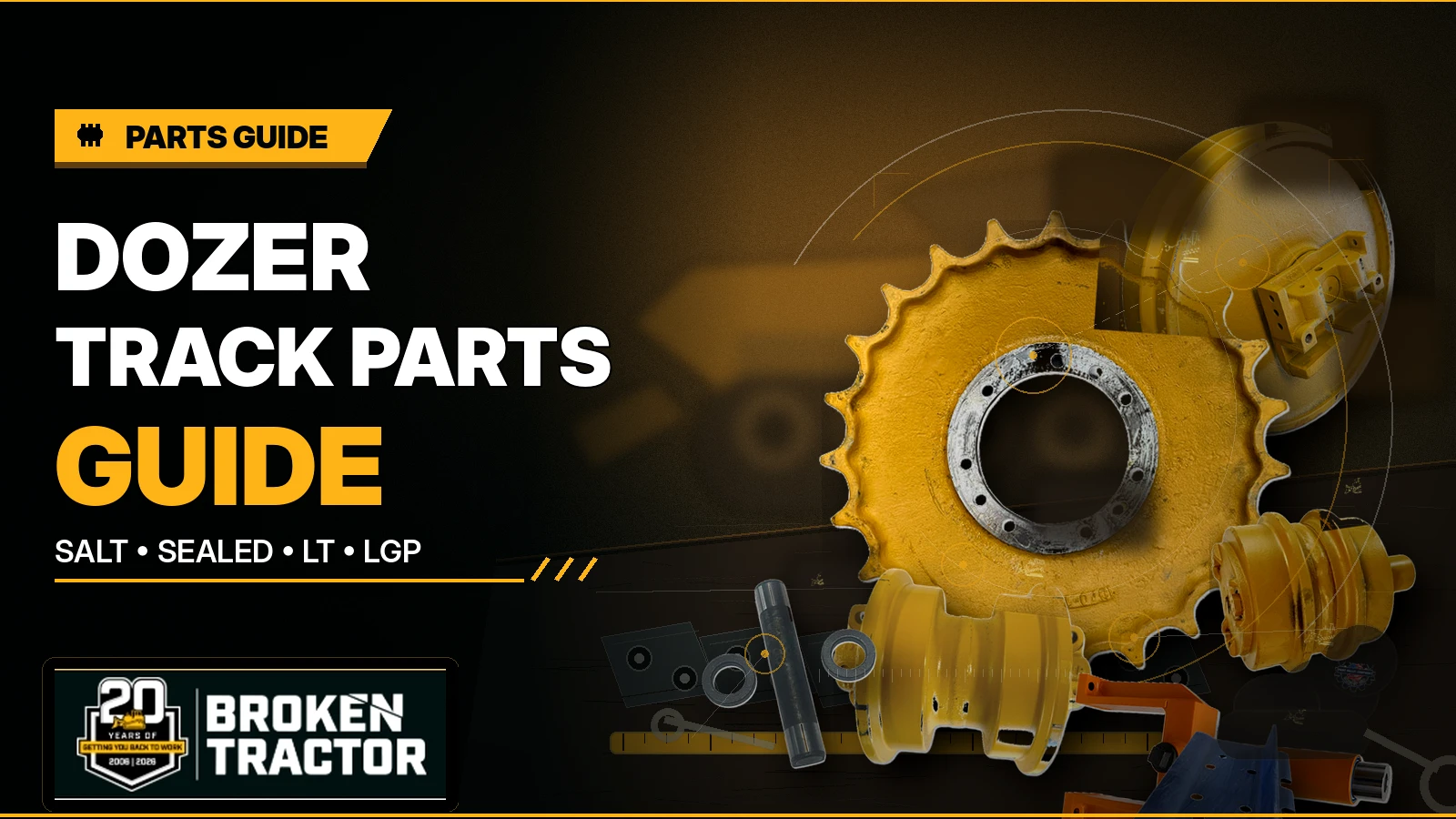
Dozer Track Guide - Salt, Sealed, LT, LGP
Posted by Broken Tractor on Jul 6th 2026
Two dozers can leave the factory the same year with the same model number and still take completely different undercarriage parts. Before you order chains, rollers, or an idler, you need to answer two questions: how your track chain is built, and how your track frame is configured. Here's how to read both right off the machine.
Call any parts counter about dozer undercarriage and the questions come fast: SALT or sealed? Standard, LT, WT, or LGP? How many bottom rollers? What's your shoe width? What's your serial number? If you can't answer, you're guessing — and undercarriage is the most expensive place on a crawler to guess wrong. A track chain ordered one link short won't tension. An LGP idler on a standard frame won't line up. Pins and bushings for a greased chain won't rebuild a lubricated one.
This guide walks through every designation you'll run into — sealed and lubricated (SALT) chains, sealed “greased” chains, dry chains, heavy-duty and extended-life options, and the frame configurations Case and John Deere stamped on their machines: Standard, LT (Long Track), XLT (Extra Long Track), WT (Wide Track), and LGP (Low Ground Pressure). Then it covers the physical measurements that remove all doubt: track pitch, link count, shoe width, roller count, and gauge.
Note on scope — This article focuses on Case crawler dozers (310 through 2050M) and John Deere crawlers (350 through 850 families), because that's where most of the identification questions land. The same principles apply to Cat, Dresser/International, and Komatsu machines, and we've included those where the details differ.
What's in this guide
- The two questions that determine every undercarriage part number
- SALT, sealed, and dry chains: what's actually inside your track
- The 10-second check: reading your pin ends
- Heavy-duty and extended-life undercarriage
- Decoding the letters: Standard, LT, XLT, WT, and LGP
- Case dozer track configurations by model
- John Deere dozer track configurations
- Measuring your undercarriage: the numbers to have ready
- Serial numbers: where to find them and why they matter
- Stretched or worn out? Reading the wear before you order
- Parts reference: dozer undercarriage components we stock
The two questions that determine every undercarriage part number
Everything in a dozer undercarriage catalog branches off two facts about your machine:
1. How the track chain is built. Dry, sealed (greased), or sealed and lubricated (SALT). This decides which chains, pins, bushings, and seal kits fit — and whether a pin-and-bushing turn is even worth doing.
2. How the track frame is configured. Standard, Long Track, Extra Long Track, Wide Track, or Low Ground Pressure. This decides chain length (link count), shoe width, bottom roller count, idler and adjuster part numbers, and track gauge.
The model number alone won't answer either question. A John Deere 450H was sold with both sealed and lubricated chains. Case dozer chains were offered greased or SALT, in standard or heavy-duty versions, on the same models. And a Case 550 never existed as a “standard” machine at all — every one of them is either an LT or an LGP, so you still have to figure out which one is sitting in your yard. The rest of this guide is about answering both questions with your eyes, a tape measure, and the serial number plate.
SALT, sealed, and dry chains: what's actually inside your track
A track chain is a set of steel links joined by pins rotating inside bushings. What separates the three chain types is what protects that pin-and-bushing joint.
Dry chains are the original design: pin and bushing assembled metal-on-metal, no seals, no lubricant. Grit works into the joint, the pin and bushing grind against each other, and the chain “stretches” — not because steel is elongating, but because every joint wears a few thousandths and the pitch grows. Dry chains are common on older crawlers and on excavators, and they announce themselves: a dry undercarriage squeaks and howls at the pins, especially in a tight turn.
Sealed chains (often called greased chains) add a seal ring between the bushing end and the link counterbore. The seal keeps abrasives out of the joint, which is greased at assembly. Sealed chains are cheaper up front than SALT and were the standard fitment on a huge number of the Case and Deere crawlers we sell parts for. The joint still wears from the inside — just slower than a dry chain.
SALT chains — Sealed And Lubricated Track — turn every pin into a tiny sealed oil reservoir. The pin is drilled with a small radial hole that lets oil fill the space between pin and bushing, and seals at each bushing end keep the oil in and the dirt out for the life of the joint. As long as the seals live, internal wear nearly stops: aftermarket manufacturers commonly claim 30–50% longer chain life over greased chains, and a SALT undercarriage runs noticeably quieter. Caterpillar pioneered sealed track in the 1960s and rolled sealed-and-lubricated track across the industry's mainline crawlers through the 1970s; Case and Deere followed on their dozer lines, and by the later letter-series machines SALT was the common spec. Deere's marketing name for its sealed-and-lubricated undercarriage system on the H-series machines was Dura-Trax — if your 450H/550H/650H literature says Dura-Trax, you're looking at sealed-for-life pins and bushings with permanently lubricated rollers and idlers.
Why this changes your parts order — The three chain types use different pins, bushings, seals, and part numbers, and they're serviced differently. A sealed chain can take a conventional pin-and-bushing turn. A SALT chain can be turned two ways: a “grease turn” (press it apart, grease it, reuse the design as a greased joint — cheaper, but it's no longer oil-lubricated) or a true lubricated turn with new seals, vacuum oil fill, and new pin plugs — a job for a track shop with a press and vacuum-fill rig. On smaller machines like a Case 450 or Deere 350, many owners skip the turn entirely and put the money toward chains, because the rails often won't outlast the turned pins and bushings anyway. Knowing which chain you have is the difference between ordering the right rebuild parts and ordering scrap.
The 10-second check: reading your pin ends
Here's the single most useful check in this article, and it costs you nothing but a walk to the machine:
Look at the ends of the track pins.
- A rubber stopper or plastic plug recessed in the center of the pin end means SALT. That plug is the oil fill port — at the factory (or the track shop), a needle goes through it, a vacuum pump pulls the air out of the joint, and oil is drawn in behind it. Solid steel pin ends, end to end, mean a dry or sealed (greased) chain.
- Find the master connection. A bolted, split two-piece master link — the “crocodile” style you separate by unbolting the track shoe above it — is the typical fitment on SALT dozer chains. A conventional master pin, identified by a drilled hole or dimple in its end while every other pin is solid, points to a dry or sealed chain. (Can't find either? Clean the chain — a master link seam hides well under packed clay.)
- Look for oil. Wetness or oil staining around the pin-and-bushing joints, under the rollers, or at the front idler means a SALT chain that's blown seals and is losing its oil. That matters for what you order: a SALT joint that's lost its oil wears like a dry chain from that day forward.
- Listen. Dry pins and bushings squeal and howl under load. A SALT chain runs quiet — and a SALT chain that has started squeaking is telling you the seals are gone.
The old shop trick — After a few hours of work, check the temperature of the pin ends (an infrared thermometer is the modern way; the old-timers used a quick touch). Dry joints run hot from metal-on-metal friction; lubricated joints run warm. It's not an OEM procedure, but track mechanics have sorted chains this way for decades.
Heavy-duty and extended-life undercarriage
On top of the three chain constructions, most manufacturers offered duty tiers — and the aftermarket still does. For the Case and Deere crawlers we support, chains are commonly available in standard and heavy-duty versions of both greased and SALT construction. Heavy-duty chains carry larger or through-hardened components for high-hour, high-impact work; they also carry their own part numbers, so “HD or standard?” is a question worth settling before you order.
Cat took the tier idea furthest, and you'll hear its vocabulary used generically: General Duty and Heavy Duty conventional undercarriage, plus the extended-life systems — SystemOne (now Cat Abrasion) with its rotating-bushing cartridge design, and HDXL with DuraLink, which pairs a crowned link with a large-diameter bushing for 20–40% more wear life in high-impact work. One field note if you run Cat iron: a rotating-bushing (SystemOne/Abrasion-type) track uses a one-piece pin-and-bushing cartridge, and the bushing is meant to rotate freely. You can't “turn” those bushings — the cartridge itself is the service part. If your D-series has a bushing that spins by hand, that's the design, not a failure.
For Cat undercarriage components we stock — including the track adjuster and recoil spring assembly for the D6K and D6K2 (239-8247) and the matching track adjuster yoke (382-6529) — browse the Cat dozer undercarriage category.
Decoding the letters: Standard, LT, XLT, WT, and LGP
Chain construction is question one. Question two is the frame configuration — the letters that follow the model number, and the reason two “identical” dozers take different chains, shoes, rollers, and idlers.
- STD (Standard) — the base track frame, roller count, and shoe width for the model.
- LT (Long Track) — an extended track frame with more ground contact, typically one extra bottom roller per side and a longer chain (more links) than standard. Shoe widths stay near standard. LT machines grade smoother and ride better; they're the most common configuration on later Case dozers.
- XLT (Extra Long Track) — a further stretched frame on larger, later machines (Case 1150K, 1650, 1850K, 2050M class).
- WT (Wide Track) — wider than standard, narrower than LGP. On a Case 850M, LT machines run 18–20″ shoes, WT machines 20–24″.
- LGP (Low Ground Pressure) — the flotation package: a long, wide frame, wider track gauge, the widest shoes offered (28″ on that same 850M), and often an extra bottom roller. Built for mud, sand, and finished grade. A Deere 450H LGP puts just 4.0 psi to the ground — less than a person standing on one foot.
Cat's equivalents, for cross-reference: Standard, XL (extra-long frame), XW (extra-wide — Cat's WT), and LGP.
Why the letters matter at the parts counter — Configuration changes the chain link count, the shoe width, the number of bottom rollers, and frequently the idler, adjuster, and recoil spring part numbers. Some parts span configurations — our front idler with spring kit for Case dozers (R58710-Kit) covers LGP, LT, and WT machines, while the Case track adjuster 129162A1 is specific to 6-roller frames. The listing will tell you — but only if you know what your machine is.
No plate? Count and measure. If the decals are gone and the plate is painted over, the frame configuration is still written on the machine: count the bottom rollers on one side, measure the shoe width, and measure the track gauge (center of one chain to center of the other). Those three numbers against the tables below will identify almost any configuration.
Case dozer track configurations by model
Case didn't offer every configuration on every model — which is good news, because knowing what was possible on your model narrows the answer fast. Here's the factory availability by model family (we covered this in more depth in our earlier guide, Which Undercarriage and Track Options Were Available on Case Dozers?):
| Configurations offered | Case models |
|---|---|
| Standard only | 310, 310C/D/E/F/G, 350, 350B, 450, 450A, 650, 650G, 650M, 750, 850, 850B, 850L, 1150B, 1150C, 1450 |
| Standard + LGP | 450B, 650H, 850C, 1150D, 1450B |
| Standard + LT + LGP | 450C, 850D, 1550 |
| LT + LGP (no standard!) | 550, 550E, 850E, 850G, 850K, 1150E, 1150G |
| LT + WT | 650L |
| LT + WT + LGP | 550H, 650K, 750H, 750K, 750L, 750M, 850H, 850M, 1150H, 1150M |
| XLT combinations | 1150K, 1650K/L/M, 1850K, 2050M (see full guide for exact mixes) |
A few Case-specific notes from the machines we get the most calls about:
Case 450 series — The standard 450 runs a 5-roller track frame; the 450C LT and LGP machines run 6-roller frames. Shoes were offered in 14″, 16″, and 20″ widths — our 14″ single grouser track shoe (CA408-14) fits the 450, 450B, 450C, 450C-LT, and 550-LT. Undercarriage parts for the original 450 also split at serial number 3050800, so have the plate number ready before ordering. And note the early 450s used more than one rail style with their own pins and bushings — on a pre-letter 450, measure your pitch and mic your pins before committing (more on that in the measuring section). Everything for these machines lives in our Case 450 series dozer track parts category, including the track tension adjuster for the Case 450 (R29709).
Case 550 series — Every 550 and 550E is an LT or an LGP; there is no standard 550. A 550E-LT runs 37-link sealed-and-lubricated chains with 20″ pads. The track adjuster for 550E, 550G, and 550H dozers (R58480) and the left-hand recoil spring assembly (187916A2) / right-hand recoil spring assembly (187917A2) cover the common tension-system failures on these machines. Browse the full Case 550 series track parts category.
Case 850 series — LGP arrived with the 850C, LT with the 850D, and from the 850E on there's no standard machine. An 850G LT and an 850G standard look nearly identical parked side by side, but they use different chain lengths, different roller counts, and typically different pad widths — the wrong assumption here means a chain that won't fit the frame. See the Case 850/855 dozer track parts category.
Across Case models — Bottom rollers are the highest-wear item on any of these frames. We stock the Case dozer bottom roller (R57357), the single flange bottom roller (R56593), and the top track roller (R33965), along with the 23-tooth drive sprocket (R56464) and a complete made-in-USA track adjuster (R51909). If you're splitting a chain, the Case dozer track chain master pin kit is the piece most owners forget to order.
John Deere dozer track configurations
Deere used the same alphabet: by the H-series, spec sheets list machines as LT, XLT, and LGP (the 700H, for example, came all three ways). Older 350/450 machines were mostly one base configuration with shoe-width options, which shifts the identification burden to measuring. The numbers that matter:
JD 350 family — 5 bottom rollers per side, 12″ shoes, 48″ track gauge on the 350B. Rollers cross many 350-family machines — the bottom track roller for JD 350–355D dozers and crawler loaders (AT104780) is one of our steadiest sellers — but sprocket bolt patterns and master pin dimensions are family-specific, so don't borrow part numbers from a 450 listing.
JD 450 through 450G — This family shares a 6.29″ pitch, and rails interchange across an impressive span (450, 450B, 450C, 450D, 450E, 450G). The catch that catches everyone: dozers run 36-link chains, crawler loaders run 37. If you own a 450C dozer and order chains listed for a 455 loader, you'll have one link too many. Count your shoes before you order — one shoe per link.
JD 450H — The perfect example of why this guide exists. The 450H was sold with both sealed and lubricated chains (check your pin ends), and came standard, LT, and LGP: standard and LT machines run 16″ shoes, LGP machines run 24″ shoes on a wider 69″ gauge (vs. 61″ LT), with 6 bottom rollers per side. For these machines we stock the front track idler assembly for 450H through 550K dozers (AT210558) and the track adjuster assembly for 450H/450J/450K/550H/550J/550K (PV324).
Larger frames (650–850) — The H-series and later machines carry Deere's Dura-Trax sealed-and-lubricated undercarriage. For the 750J/750K class we stock the complete track adjuster and recoil spring assembly (AT406977).
Across Deere models — Common wear and tension parts: the single-flange bottom track roller (AT71674), press-fit upper track roller kit (AT167254), dozer sprocket (T178481), track idler wheel kit (AT184193), complete track tension adjuster (PV300), track tensioner (PV303), recoil spring for 450/550/555 (T106882), and the track adjuster forked yoke (T169180). Shoes too — like the 18″ single grouser track shoe (CR2974-18). Browse the full John Deere dozer undercarriage category and the Deere track adjuster & recoil spring category.
Measuring your undercarriage: the numbers to have ready
When the plate is missing, the decals are sandblasted, or the machine's history is three owners deep, the undercarriage itself tells the truth. These are the measurements a parts counter will actually use, in the order they'll ask for them.
Track pitch: the most important number on the machine
Pitch is the center-to-center distance between pins, and it's the fingerprint of a chain family. To measure it: clean a section of chain, tension the track so the joints are pulled tight, then measure across five consecutive pin centers with a steel tape and divide by four. Measuring over four pitches averages out joint-to-joint variation; center-punching the first and fifth pins makes the tape placement repeatable.
Worn chains always measure long — A stretched chain is exactly why you're measuring, so compare against the new spec, not your tape. A pre-letter Case 450's chain specs 5.875″ new; owners routinely measure a worn one at 6″ and wonder which chain they have. A JD 450-family chain specs 6.29″ new. If your measurement lands a bit over a listed new pitch, that's the chain — just worn. If it lands between two chain families, call us with the serial number.
Link count
Count the shoes around one chain — one shoe per link, and the master link or master pin position counts as one. Mark your starting shoe with chalk. The count must match your track frame: a chain one link long or short won't tension within the adjuster's travel. Remember the Deere rule from above (36-link dozer, 37-link crawler loader) and the Case 550E-LT's 37-link chains.
Shoe width and grouser style
Tape straight across a shoe. Checked against the configuration tables, this single number often settles the LT/WT/LGP question: a 24″ shoe on a JD 450H means LGP; a 28″ shoe on a Case 850M means the same. Note the grouser style while you're down there — single-bar grousers are the standard dozer traction shoe; triple-bar shoes usually mean a crawler loader or a machine that lives on hard surfaces.
Roller count and track gauge
Count bottom rollers and carrier (top) rollers on one side — 5 vs. 6 separates a standard Case 450 from a 450C LT/LGP frame. Then measure track gauge, center of one chain to center of the other; the cleanest field method is measuring sprocket-to-sprocket, which we walk through in How to Measure Track Gauge on Dozers and Excavators. On a 450H, gauge alone separates LT (61″) from LGP (69″).
Sprocket teeth and bolt holes
Count the sprocket teeth (our Case sprocket R56464, for instance, is a 23-tooth). If you're ordering shoes, measure the bolt hole diameter and the hole spacing on the link — some machines changed hardware mid-run. Dresser's TD7E used 1/2″ shoe bolts while later TD8E chains moved to 9/16″, and the chain construction changed with them.
One more habit that saves phone calls — Before you measure anything, wipe the mud off a link side and look for the part number forged or cast into the steel. Chains, rollers, and idlers usually carry their numbers on the part itself, and a legible casting number beats every measurement above.
Serial numbers: where to find them and why they matter
Even after you've identified the chain type and configuration, the serial number is what locks in the exact part number, because manufacturers changed undercarriage components mid-model without changing the model name.
Where to look on Case dozers — On a Case 450, check the left frame rail near the radiator; the number is also stamped into the operator's station sheet metal. On a 450B, check the front of the battery compartment. If the tag is gone, clean the frame rails — the number is stamped into the steel, not just riveted on.
Where to look on Deere crawlers — The ID plate sits on the left side of the machine frame just behind the track, or under/behind the operator's seat depending on the model. On a 450C, the number is also stamped into the metal behind where the tag mounts. On later PIN-style plates, the first four digits after the prefix are the model and the last six are the serial.
What a serial break looks like in practice — Case 450 undercarriage listings split at SN 3050800 — the same part search returns different components before and after. On the 550 family, sprocket R57298 fits the 550E, 550G, 550H, and plain 550s — but only after SN JAK0013968. Machine age adds a wrinkle too: dozers get resold with paperwork that drifted from reality, and more than one owner has discovered their “1979 450B” was a 1969 450 once they found the stamp. The serial number settles arguments the paint can't.
Stretched or worn out? Reading the wear before you order
Identification and wear assessment overlap, because worn parts lie. Three things to know before you finalize an order:
Pointed sprocket teeth don't automatically mean a bad sprocket. Sharp, hooked teeth usually reflect a stretched chain riding up the tooth profile — the root of the tooth is the working surface. But the pairing rule holds: whenever you install new chains or turn pins and bushings, install new sprockets or segments. Old sprockets are worn to the old chain's stretched pitch and will eat a new chain alive.
The turn-or-replace math. The textbook window for a pin-and-bushing turn is when the bushings are about 100% worn on the drive side and the rails are around 50%. If the rails are close to done too, skip the turn and put the money toward chains. On small crawlers — the Case 450/JD 350 class — many owners find the turn isn't worth the shop bill at all, because the rails won't outlast the freshly turned pins and bushings.
Measure wear on clean steel. Link height (depth gauge from shoe surface to rail top near a pin), bushing OD (caliper at the most-worn point, square to the axis), and roller tread diameter all convert to percent-worn against OEM tables — and a tenth of an inch of packed clay will throw every one of those numbers off. For reference, a JD 450E's grouser specs 1.89″ new and is called 100% worn at 0.79″.
While you're under there, check the tension system itself. A track that won't hold adjustment isn't always a stretched chain — leaking adjuster seals are the everyday culprit, and on Dresser machines the track adjuster seal kit (906001) is a cheap fix compared to a complete Dresser track adjuster (PV307X) or the TD8/125-series 5-roller version (PV308X).
Parts reference: dozer undercarriage components we stock
Once you know your chain type, configuration, and serial number, here's where the common parts live. Every listing includes fitment detail — and if you're not sure, send us the serial number and your measurements and we'll confirm before it ships.
Case dozer undercarriage
| Part | Number | Fits / Function |
|---|---|---|
| Track adjuster assembly | R58480 | 550E, 550G, 550H dozers |
| Front idler with spring kit | R58710-Kit | Case & New Holland dozers — LGP, LT, WT frames |
| Track adjuster, 6-roller | 129162A1 | Case 6-roller track frames |
| Complete track adjuster | R51909 | Case dozers, made in USA |
| Track tension adjuster | R29709 | Case 450 dozer |
| Track adjuster, left hand | 435384A1 | 650K, 850M (Tier 4A) |
| Recoil spring assembly, RH | 187917A2 | Case dozer recoil, right hand |
| Recoil spring assembly, LH | 187916A2 | Case 450–550G dozers |
| Recoil spring assembly | 334260A1 | Case 650–855E dozers |
| Bottom roller | R57357 | Case dozer track frames |
| Single flange bottom roller | R56593 | Case dozers |
| Top track roller | R33965 | Case dozers |
| Drive sprocket, 23-tooth | R56464 | Case loaders and dozers |
| 14″ single grouser track shoe | CA408-14 | 450, 450B, 450C, 450C-LT, 550-LT |
| Track chain master pin kit | — | Splitting/joining Case dozer chains |
John Deere dozer undercarriage
| Part | Number | Fits / Function |
|---|---|---|
| Single-flange bottom roller | AT71674 | JD dozers and track loaders |
| Bottom track roller | AT104780 | JD 350–355D dozers, crawler loaders |
| Upper track roller, press-fit | AT167254 | JD dozers |
| Dozer sprocket | T178481 | JD dozers |
| Track idler wheel kit | AT184193 | JD dozers and crawler loaders |
| Front track idler assembly | AT210558 | 450H–450P, 550H–550K |
| Complete track tension adjuster | PV300 | JD dozers |
| Track tensioner | PV303 | JD crawler dozers |
| Track adjuster assembly | PV324 | 450H/J/K, 550H/J/K |
| Track adjuster & recoil spring | AT406977 | 750J, 750J-II, 750K |
| Recoil spring | T106882 | JD 450, 550, 555 |
| Track adjuster forked yoke | T169180 | JD dozers |
| 18″ single grouser track shoe | CR2974-18 | JD dozers |
Cat and Dresser
For Cat machines: the D6K/D6K2 track adjuster and recoil spring (239-8247), the matching adjuster yoke (382-6529), and the D3C/D4C track tension adjuster and recoil spring kit (PV339). For Dresser/IH: the TD7-series track adjuster (PV307X), TD8/125-series adjuster (PV308X), and the adjuster seal kit (906001).
Browse by machine
Full category browsing: Case dozer track & undercarriage parts (organized by model series — 450, 550, 650, 750, 850/855, 1150/1155), John Deere dozer undercarriage, Cat dozer undercarriage, and IH Dresser dozer parts. Looking for complete track chains? We source SALT and sealed chains for most Case and Deere models — they're not all listed online, so call with your model, link count, and chain type.
Sorting out the undercarriage on your dozer?
Chains, rollers, idlers, sprockets, adjusters, and recoil springs for Case, John Deere, Cat, and Dresser crawlers — fitment-verified for your machine and shipped from U.S. warehouses. Have your serial number, link count, and shoe width handy and we'll confirm the right parts before anything ships.
Shop Dozer Track & Undercarriage Parts
Broken Tractor Editorial Team
Broken Tractor LLC stocks undercarriage parts for Case, John Deere, Caterpillar, and Dresser/International crawler dozers — track adjusters, recoil springs, rollers, idlers, sprockets, grouser shoes, and master pin kits. Specifications referenced in this article are drawn from factory spec sheets and technical manuals for the machines covered; always confirm against your serial number before ordering.
Keep reading
- Case Identification — Which Undercarriage and Track Options Were Available on Case Dozers?
- How-To — How to Measure Track Gauge on Dozers and Excavators: The Sprocket-to-Sprocket Method
- Case Track Parts — Case 450 Series Dozer Track Parts
- Repair Guide — Case 480C, 580C & 580D Backhoe Brake Repair: Complete Walkthrough