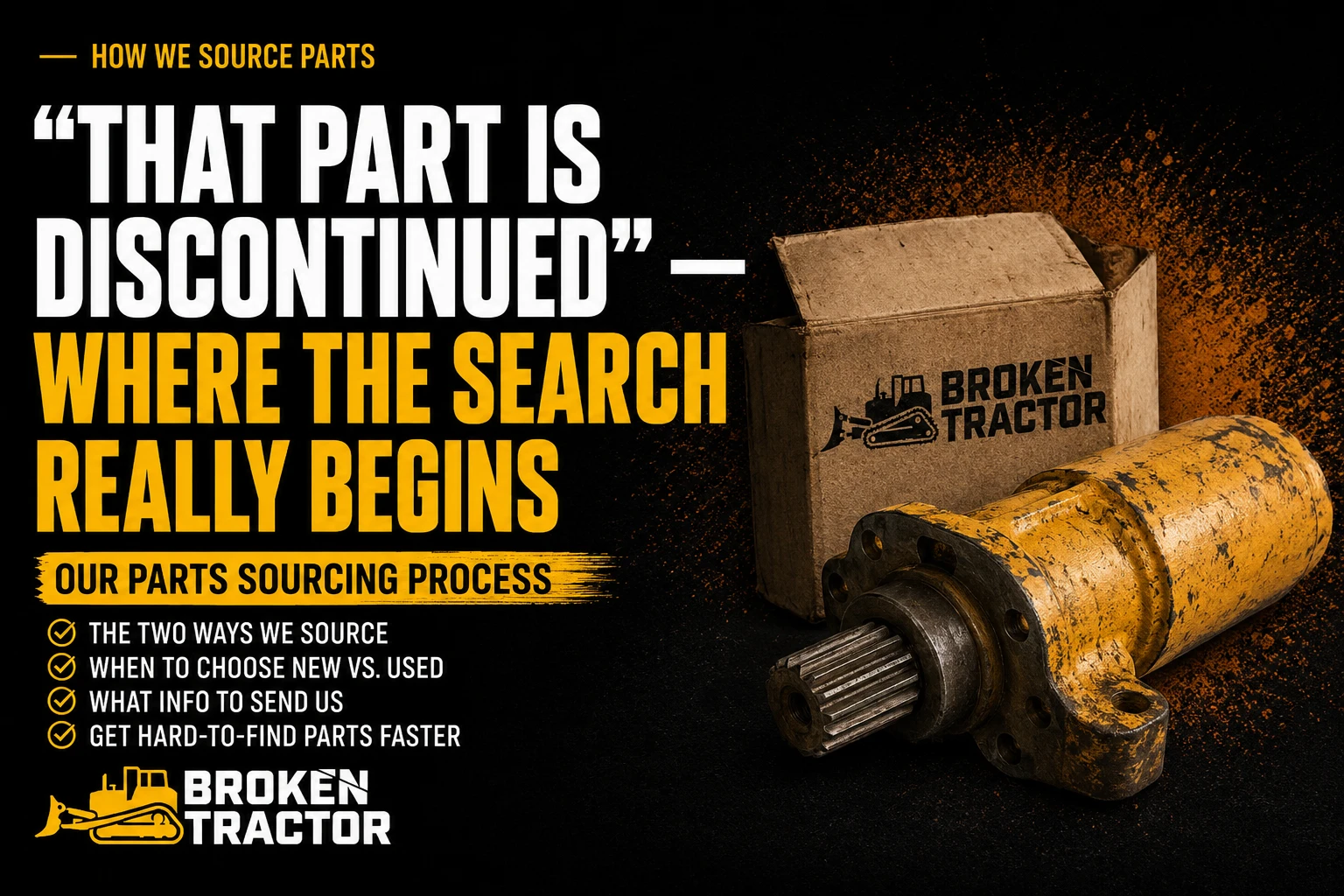
"That Part Is Discontinued" — Where the Search Really Begins
Posted by Broken Tractor on Feb 17th 2026
When the dealer tells you the part is discontinued, the part isn't actually gone. It's sitting in a salvage yard waiting to be found. Here's how we source hard-to-find parts that the OEM supply chain has given up on — and what to send us so we can move fast. If you've owned an older machine long enough, you know the conversation. You call the dealer with a part number. The voice on the other end taps at a keyboard. There's a pause. Then: "That part's been discontinued." Or: "Backordered with no ETA." Or: "Obsolete." Or some version of the same — your part doesn't exist in their system anymore. For most people, that's where the search ends. The dealer told you it can't be found, so it can't be found. Here's the thing the dealer didn't tell you: the part is almost certainly still out there. It's bolted to a machine that got parked behind a barn in 2003, or sitting on a shelf in a salvage yard in Ohio, or stacked with a thousand other parts in a warehouse in Louisiana. It's just no longer in the OEM's official supply chain — which is the only place the dealer looked. Finding it is what we do. When a manufacturer discontinues a part, it doesn't disappear from the world. It just stops being manufactured and stops being supported through the dealer network. Three things happen next: A dealer parts counter has access to the first lane. Sometimes the second, if they stock aftermarket. Rarely the third. That's the gap we exist to fill. For parts that are still in production or available aftermarket, this is straightforward. We have direct relationships with OEM distributors, aftermarket manufacturers, and remanufacturers. If a part is still being made — by anyone — we can usually quote it within a day. For many older machines, the aftermarket option is actually better than the original OEM part: same fitment, often improved materials, frequently lower price. Most of what's listed on brokentractor.com falls in this lane. For everything else, we work the salvage side. This is where our family business background matters: we've been in the equipment parts and salvage business for over 50 years. That's two warehouses, our own yards of dismantled machines, and a network of relationships with dismantlers and parts locators across the country. We're not just calling out to the network — we're part of it. When another dealer somewhere needs a hard-to-find Case backhoe corner assembly, sometimes they're calling us. When we need a part we don't have, we send a targeted request into the network and machines all over the country get checked. The kinds of parts we routinely source through the salvage lane: Used isn't always the answer. Sometimes new is the right call, sometimes it's the only safe call. Here's how we think about it: Our job isn't to push one over the other. It's to give you the option that gets you working again at the right cost. We'll quote both when both exist — you decide. Whether the part ends up coming from a warehouse or a salvage yard, the speed of the search depends almost entirely on the quality of the information we get up front. The faster you send us complete information, the faster we can quote and ship. The most useful information includes: Send all that to parts@brokentractor.com, or use the parts request form, or call (800) 909-7060. We'll work both lanes — dealer pipeline and salvage network — and come back with the fastest path to having the part on a truck. "Discontinued" is what dealers say when their catalog runs out of options. It almost never means the part is actually unavailable. For machines old enough to have aged out of OEM support, our salvage lane finds parts that the dealer system stopped tracking years ago. If you've been told the part you need doesn't exist anymore, send us the details. We've probably found one before. Send us your machine make and model, serial number, and a photo of what you're replacing. We'll work both the standard supply chain and our salvage network — and come back with the fastest path to having the part in your hands."That Part Is Discontinued" — Where the Search Really Begins
What "discontinued" actually means
The two ways we source
Lane 1 — The standard supply chain
Lane 2 — The salvage network
What gets found this way
When salvage is the right answer (and when it isn't)
Go new (OEM or aftermarket)
Go used (salvage)
Safety-critical parts — brakes, steering, ROPS components
Sheet metal where cosmetic condition matches the rest of the machine
Wear parts that benefit from new materials — bearings, seals, gaskets
Heavy castings that don't wear in normal use
Parts where warranty coverage matters
Discontinued items the aftermarket never picked up
Anything where dealer cost is still reasonable relative to machine value
Anywhere dealer cost exceeds the machine's remaining value
Cylinders and pumps where rebuild risk is high
Brackets, sub-frames, mounting hardware
How to get a hard-to-find part fast
The bottom line
Need help finding a hard-to-find part?