Slip Clutch vs. Shear Pin on a King Kutter Rotary Cutter: Which Is Right for You?
Posted by Broken Tractor on May 19th 2026
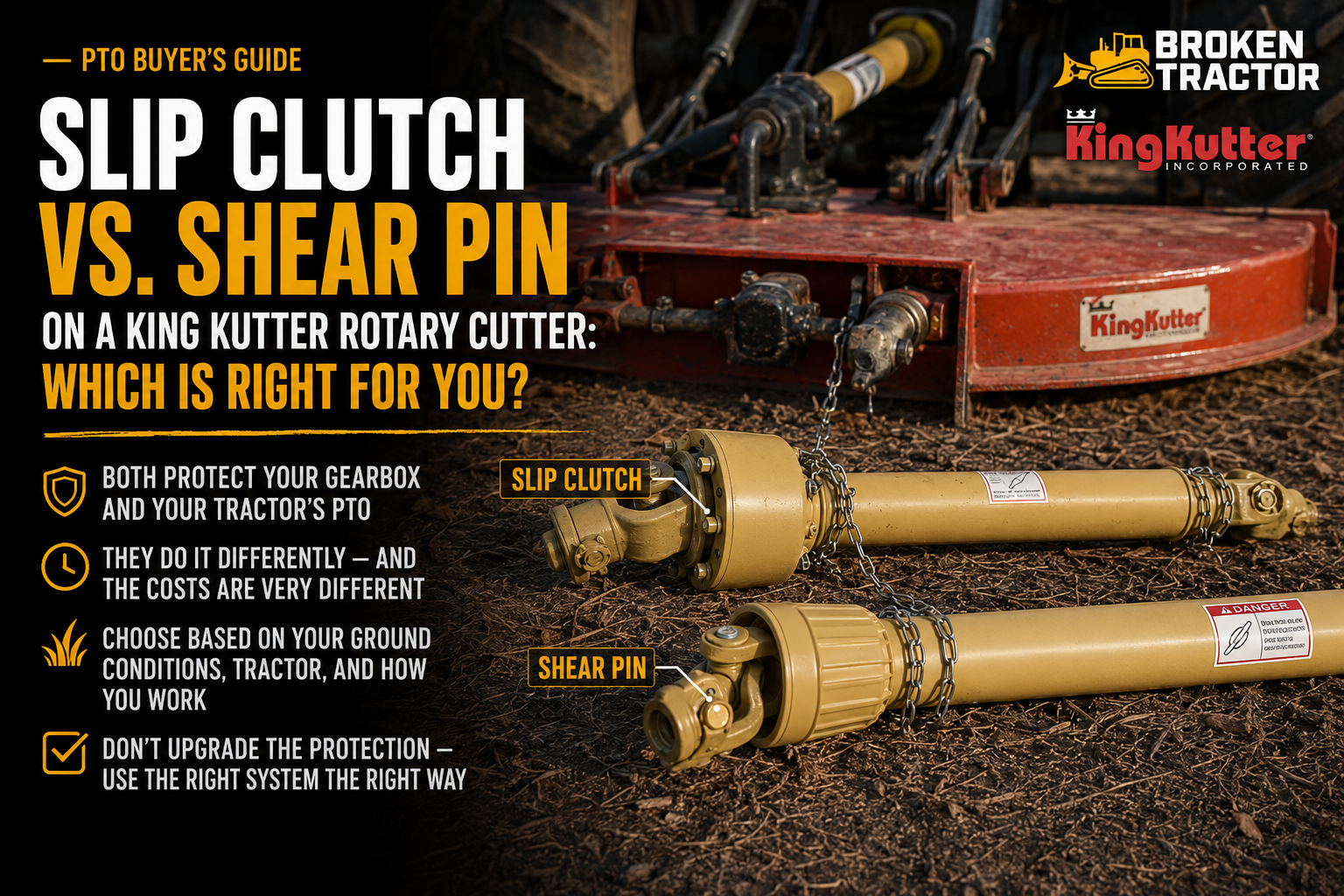
Both systems protect the same thing — your gearbox and your tractor's PTO. They do it differently, and they have very different costs in time, money, and aggravation. Here's how to choose based on what you actually mow. Walk into any farm-supply store and you'll see King Kutter rotary cutters offered in two flavors at the same width — one with a shear-pin PTO shaft, one with a slip-clutch shaft, usually about $250 apart in price. The forums are full of opinions about which is better, and most of them are right. The honest answer is that one isn't universally better than the other. They're built for different operators, different properties, and different tractors. A rotary cutter's PTO drive connects your tractor's powerful PTO output to a gearbox that spins the blades. When the blades hit something they can't cut — a stump, a rock, a buried fence post — that shock load travels straight back up the driveline. Without a sacrificial element somewhere in that chain, the shock has to go somewhere. Usually it goes into a $400 gearbox or a $1,500 PTO repair inside your tractor. Both systems break that chain on purpose, just in different ways. A specifically-graded bolt or pin sits in the PTO driveline. When shock load exceeds its design strength, the bolt shears in half and disconnects the blades from the tractor. Cheap, simple, no moving parts, no maintenance — until it breaks. Then you have to find the broken halves, line up the holes, drive in a new bolt, and start mowing again. A spring-loaded friction pack on the shaft. Under normal load, friction holds the two halves of the shaft locked together. When shock load exceeds the friction setting, the clutch slips — the blades momentarily decouple from the tractor — then re-engage as soon as the load returns to normal. No parts to replace, no holes to line up, you keep mowing. Three factors decide it. This one surprises operators. Modern compact tractors with electric-over-hydraulic PTOs engage violently — they go from zero to full speed faster than older mechanical PTOs. That fast engagement alone, with no obstacle, can shear a Grade 2 bolt before the blades even start spinning. Forum-tested example: an operator on a Bobcat Toolcat with an electro-hydraulic PTO went through 17 shear bolts before installing a slip clutch. This is the maintenance most operators skip and the maintenance King Kutter's manual specifically requires. It takes ten minutes. Keep spares in the tractor toolbox. Always. Running out of pins in the middle of a five-acre field is its own kind of misery. Sort of, but with a caveat most articles don't mention: the cutter's gearbox input shaft must match the system. King Kutter sells the 40 HP, 60 HP, and 80 HP gearboxes in both shear-bolt and slip-clutch input configurations — they are not interchangeable inside the gearbox. If you want to convert a shear-pin cutter to slip-clutch (the more common direction), you have two options: Going the other direction (slip clutch to shear pin) is uncommon. The only reason to do it is if you can't or won't maintain the slip clutch — in which case you should also reconsider whether the cutter is the right tool for the property. If you're buying a cutter today, here's the short version of the recommendation: Shear pin kits, slip clutch service parts, complete PTO shafts (both styles), gearbox input shafts, and full rotary cutter replacement parts. Official King Kutter parts dealer since 2006.What each system actually does
The shear pin (or shear bolt)
The slip clutch
The honest trade-offs
Shear Pin
Slip Clutch
Upfront cost
Cheaper — typically $50–$250 less than the same cutter with a clutch shaft
More expensive
Maintenance
Almost none — just keep spare pins in the toolbox
Annual: loosen the spring nuts, verify the discs aren't rusted together, re-tighten to spec
Recovery from a hit
Stop, get out, find the broken halves, drive out the old pin, install a new one. 2–5 minutes if you have parts on the tractor; longer if you have to drive home
Keep mowing. The clutch slipped and reset itself before you noticed
Risk if neglected
None — pins don't seize up. They either break or they don't
If left outside through wet seasons without annual exercise, friction discs can rust solid. A locked clutch transmits full shock load to the gearbox. Catastrophic failure mode
Risk if used wrong
Using a Grade 5 or Grade 8 bolt in place of the specified Grade 2 — the bolt becomes stronger than the gearbox. The gearbox breaks instead of the bolt
Over-tightening the spring nuts — the clutch never slips, full shock load goes to the gearbox. Same outcome as the wrong-grade bolt
Frequency for typical use
Hit something hard, change a pin. Operators with rocky or stumpy ground report changing 3–10 pins per season
Hit something hard, you may not even notice. Most operators go years without thinking about the clutch except to exercise it
Which one is right for you?
1. What ground are you mowing?
2. How does your tractor's PTO engage?
3. Where is the cutter stored?
How to exercise a slip clutch (do this every spring)
Parts for either path
If you have a shear-pin setup
If you have a slip-clutch setup
Can you convert from one to the other?
The honest bottom line
Need parts for your King Kutter cutter?