
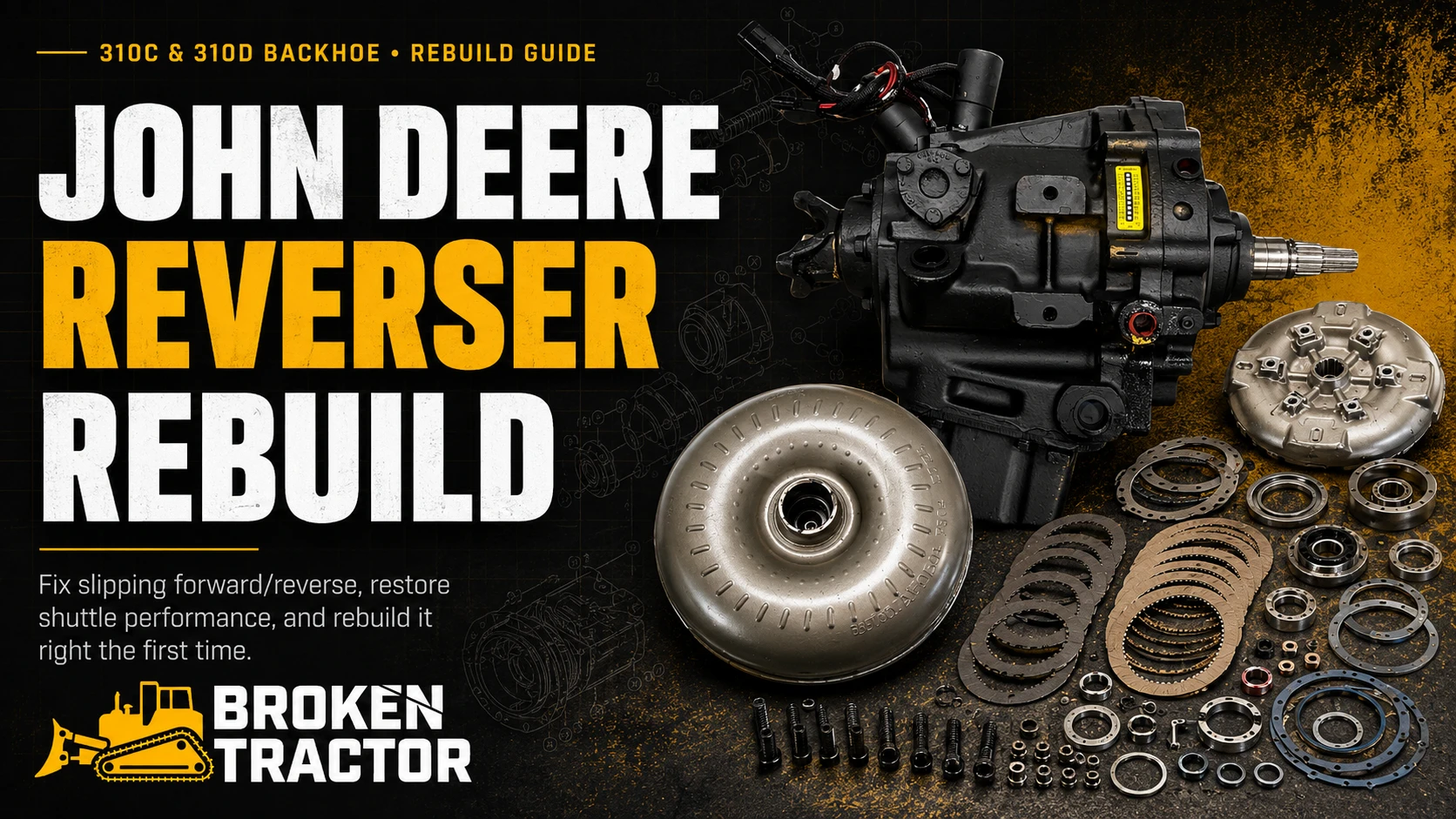
How to Rebuild the Reverser Transmission on a John Deere 310C or 310D Backhoe
Posted by Broken Tractor on May 6th 2026
If your 310C or 310D is slow rolling into forward, drops out of reverse under load, or shifts hard between directions, the reverser is almost certainly the culprit. Here's the full rebuild walkthrough — symptoms, diagnostic flow, complete teardown, factory torque specs, and the one snap-ring step that determines whether your work lasts 5,000 hours or 500.
The reverser on a John Deere 310C or 310D is the hydraulic clutch-pack transmission that lets the operator change direction without dragging the master clutch. Two wet clutch packs — forward and reverse — engage hydraulically through a control valve, driving a pinion-cage output shaft. A charge pump hanging off the front feeds the apply pressure, and a torque converter bolted between the engine flywheel and the reverser housing handles the input side. The whole architecture is durable, but it's also a system that fails in characteristic ways once the friction material starts to glaze or the pump starts to wear.
Done right, a reverser rebuild on a 310C/310D is a long shop weekend that returns a 30-year-old machine to factory function for a fraction of the cost of a replacement transmission. Done wrong — wrong snap ring, mixed clutch discs, dirty oil cooler, forced installation — it fails in weeks and costs you the rebuild twice. This guide walks the entire job using factory rebuild specifications, then points to the exact rebuild kits and individual components that fit the 310C/310D.
What's actually inside the reverser
Strip away the housing and the 310C/310D reverser is a small handful of components doing one job: routing engine power through one of two hydraulically applied clutch packs to deliver forward or reverse output. The major sub-assemblies are:
- Charging pump — bolts to the cover and supplies fluid pressure to the control valve and clutch circuits
- Control valve — contains the pressure-regulator piston, valve spring and seat, clutch-cutout solenoid, and the directional valve plunger
- Cover assembly — houses the reverse clutch piston and seals against the housing with a Ferry-head-screw flange
- Reverse clutch pack — pressure plate, springs, and alternating friction discs and metal discs
- Input shaft and forward clutch — input shaft with Woodruff key, clutch hub, ring gear, cylinder, piston with quad ring, clutch spring, friction discs, metal discs, and front and rear pressure plates
- Pinion cage and output shaft — the planetary-style output, with pinion gears, needle bearings, thrust plates, and a collector ring rolled onto the back
- Bearing retainer — captures the rear bearing and indexes the output shaft
- Torque converter — bolts to the flywheel via a flex plate, drives the input shaft, holds several quarts of fluid internally
Every one of those sub-assemblies is a serviceable part of a rebuild, and every one has a failure mode. Knowing which sub-assembly is failing is the difference between a 12-hour focused rebuild and a 40-hour parts-cannon.
Symptoms and what each one tells you
Most reverser complaints fall into a small number of repeating patterns. Read the symptom carefully — it points you at the failed sub-assembly before you turn a wrench.
| Symptom | Most likely cause | What to inspect first |
|---|---|---|
| Slips into forward, reverse is fine | Forward clutch friction discs glazed or worn; forward piston seal failed | Forward clutch pack and forward piston quad ring |
| Slips into reverse, forward is fine | Reverse clutch discs glazed; reverse pressure-plate spring fatigued or broken | Reverse clutch pack and pressure-plate springs |
| Both directions weak when warm, fine when cold | Internal pump leakage; pressure regulator piston worn | Charge pump output and pressure regulator in the control valve |
| No movement either direction, no relief whine | Failed charge pump or input drive; broken flex plate to torque converter | Pump output, flex-plate cap screws and bolt torque |
| Hard shift, banging engagement | Sticky valve plunger in control valve; contaminated fluid causing erratic pressure | Control valve and fluid condition |
| Brown or burnt fluid, sweet burnt smell | Friction material has overheated and is shedding into the case | Plan a full rebuild and flush the cooler aggressively |
| Metallic glitter in oil pan | Bearing failure in pinion cage, output shaft, or input bearing | Drain pan inspection, then full teardown |
| Leaks at front of unit | Charge pump shaft seal — the only seal sold separately on the pump | Charge pump body seal |
The "cold works, hot doesn't" pattern is one of the most common — and most misdiagnosed. Cold oil is thicker, so even a marginal pump can build pressure to engage the clutches. As the oil warms and thins, worn pump clearances bleed off pressure and the reverser starts to slip. If the machine pulls fine on the first lap of the morning and gets weak after twenty minutes, you're chasing pump wear, not clutch wear. A complete kit like the John Deere Backhoe Transmission Reverser Rebuild Kit with Torque (JD-CRRK) bundles a high-output charge pump alongside the clutch and bearing components for exactly this reason.
Diagnostic flow before you pull anything
A reverser is not a unit you want to pull twice. Spend an hour confirming the diagnosis before you spend a weekend pulling the box.
- Check the fluid first. Pull the dipstick. Note color and smell. Brown and burnt = friction failure. Milky = water intrusion (often from a leaking cooler). Bright metallic = bearings. Dark but clean = probably just old oil, but not the root cause.
- Inspect the screen and filter. The 310C/310D reverser is notorious for filter plugging in the cast aluminum filter can. A plugged filter starves clutch apply pressure and looks exactly like clutch wear. Pull and inspect before you assume the clutches are bad.
- Pressure test the clutch circuits. Tee a 0–600 psi gauge into the forward and reverse apply ports. Healthy pressure rises quickly to spec on shift, holds steady, and drops cleanly on neutral. Pressure that rises slowly indicates pump wear; pressure that won't hold indicates piston seal bypass; no pressure at all in one direction indicates a stuck valve or a destroyed piston.
- Verify the solenoid. The reverser uses a clutch-cutout solenoid wired to the shifter and shuttle lever. Unplug it as a quick test — if behavior changes, the electrical chain is suspect; if not, the problem is mechanical.
- Look at the cooler lines. A restricted oil cooler is a classic root cause that gets blamed on the transmission. The reverser dumps return oil through an external cooler, and if that cooler is plugged with debris from a previous failure, you'll cook the new clutches in the first 50 hours.
Rebuild kits, tools, and reference specs
Rebuild kits
Kit selection depends on how deep the failure goes. For a focused clutch-pack rebuild on a unit where the rest of the reverser is healthy, a clutch-and-plate kit covers what you actually need. For a unit that's been operated past the point of friction material failure, a master kit with new bearings, the torque converter, and the charge pump is the better long-term value.
- Clutch and plate level — for friction-disc replacement only on a known-clean unit. The Reverser Clutch and Plate Rebuild Kit for John Deere 310C/310D backhoes (A574005) includes the friction discs, spacer discs, and spacer plates required for a complete clutch-pack swap.
- Full overhaul — for a unit with worn bearings, bushings, or seal damage. The Complete Reverser Overhaul Kit for JD 210C, 310C, 310D, 315C, 315D, and 482C (A574012) adds the full bearing set, gasket and seal kit, and discs.
- Master with torque converter — for the rebuilds where you want everything new at once. The John Deere Backhoe Transmission Reverser Rebuild Kit with Torque (JD-CRRK) bundles a remanufactured torque converter, high-output charge pump, and the full disc, bearing, and gasket set.
If you're buying individual wear parts, the forward clutch drive disc (AT101001), the metallic reverse clutch friction disc (AT100837), the forward-reverse clutch steel spacer plate (T158801), and the reverse clutch piston seal (D50034) are the most commonly replaced components on a 310C/310D rebuild. Browse the full John Deere backhoe reverser parts collection for everything else.
Tools
- Transmission jack (the unit weighs roughly 100 lb, plus another 30 lb for the converter)
- Drain pan with at least 3 U.S. gallon capacity
- Bench press for clutch hub and ring gear separation
- Soft-jaw vise
- Acceptable bearing puller and seal puller
- Compressed air for piston removal from the cover
- Torque wrench (10–100 ft-lb range covers everything in this job)
- Petroleum jelly for thrust-washer staging during reassembly
- Cleaning solvent — every metal component gets cleaned, every O-ring, seal, sealing ring, and gasket gets discarded
Reference specs
The figures below are the factory rebuild specifications for this style of hydraulic clutch-pack reverser. Always cross-reference your John Deere service manual for any values that are sensitive to your specific serial number range, and treat these as the working bench reference.
Component weights
- Reverser unit (approx.)
- 100 lb / 45 kg
- Torque converter (approx.)
- 30 lb / 14 kg
Spring specs (compressed length)
- Pressure regulator
- 2.073 in @ 74–82 lb
- Reverse clutch pressure plate
- 1.000 in @ 13.5–16.5 lb
Special torques
- Rear bearing retainer cap screws
- 40–50 ft-lb
- Yoke
- 75–85 ft-lb
- Cover assembly Ferry head screws
- 27–37 ft-lb
- Charging pump cap screws
- 17–22 ft-lb
- Reverser mount cap screws
- 45–55 ft-lb
- Flex plate to torque converter
- 28–32 ft-lb
- Flex plate to flywheel
- 13–15 ft-lb
- Driveshaft to yoke
- 13–18 ft-lb
- Torque converter housing cap screws
- 30–35 ft-lb
Removal: getting the unit out cleanly
The factory removal sequence runs as follows:
- Apply the parking brake.
- Drain the oil from the reverser and the torque converter into a 3-gallon-capacity pan. Remove the dipstick, remove the plug in the bottom of the torque flywheel housing, turn the flywheel until the converter drain plug is above the access hole, remove the converter drain plug, then remove the drain plug from the reverser itself.
- Loosen and remove the clamp holding the top of the fill tube.
- Loosen the nut at the bottom of the fill tube completely, then remove the fill tube.
- Loosen and remove the cap screws and clamps holding the drive shaft. Remove the drive shaft.
- If equipped with a backup alarm, loosen the screws in the switch and remove the wires.
- Disconnect the wiring harness from the neutral switch and the parking brake buzzer switch.
- Disconnect the linkage to the control arm.
- Disconnect the bottom hose from the reverser, then immediately cap the fitting and plug the hose.
- Disconnect the top hose, again capping and plugging.
- Fasten the transmission jack to the reverser.
- Loosen and remove the cap screws and lock washers holding the reverser to the bell housing.
- Move the reverser to the rear, lower it on the jack, and remove it from under the machine.
Cap every fitting, plug every hose
Every uncapped fitting is a contamination opportunity, and contamination is the root cause of most "rebuild that didn't last" calls. Use clean rubber caps and plastic plugs, not shop rags. The minute it takes to cap a hose saves the rebuild.
Disassembly: inside the housing
With the unit on the bench, the factory teardown sequence runs roughly as follows:
- Remove the oil pan cap screws and lock washers, then lift off the oil pan. Inspect the pan immediately — what's in there tells you what's failed inside.
- Place the reverser on the bench, oil-pan side up.
- Remove the cap screws fastening the charging pump to the cover. Lift the charging pump off.
- Remove the cover assembly. The cover houses the reverse clutch piston — apply compressed air to the piston supply hole to push the piston out of the cover for cleaning.
- Remove the reverse clutch pressure plate and reverse clutch springs from the housing.
- Remove the friction discs and metal discs from the reverse clutch pack. Important rule: all friction discs must be replaced at the same time, and all metal discs must be replaced at the same time. There is no mixing of old and new.
- Remove the bearing retainer cap screws. Hit the bearing retainer with a soft hammer to free it from the housing. If the needle bearing inside the housing is damaged or worn, measure and record the distance from the edge of the housing to the end of the needle bearing — you'll need this dimension to set the new bearing depth correctly.
- Lift out the input shaft and forward clutch assembly along with the pinion cage and output shaft.
- Disassemble the input shaft and forward clutch assembly: remove the snap ring fastening the clutch hub to the input shaft, press the input shaft out of the clutch hub, remove the Woodruff key, separate the cylinder and piston from the ring gear, remove the front pressure plate, remove the friction discs and metal discs, remove the clutch spring, remove the snap ring fastening the bearing in the cylinder, and remove the bearing.
- Disassemble the pinion cage and output shaft only if the pinion gears or pinion bearings are damaged. The collector ring on the back of the pinion cage is rolled into position by a lathe operation and requires a machine shop to reinstall correctly. If your local machine shop can't do it, plan on a complete pinion cage and output shaft assembly instead.
- Disassemble the control valve: compress the pressure regulator spring, remove the snap ring, release the valve spring slowly, remove the spring seat and valve spring, then remove the pressure regulator piston.
Inspection: what to keep and what to scrap
Clean every metal part in cleaning solvent. Discard all O-rings, seals, sealing rings, and gaskets — they are one-use parts. Then make a keep-or-scrap call on every remaining component.
Charging pump
Only the body seal is sold separately. If any other charging pump component is worn — gear faces, bushings, body, or converter support — replace the entire pump. Pump parts can look serviceable while still being too worn to make adequate flow; if your earlier pressure test showed inadequate flow, replace the pump regardless of how it looks on the bench.
Cover assembly
Inspect the cover for cracks, pitting, and scoring in the piston bore area. Make sure all internal passages are free of debris. Press a new bushing into the cover during reassembly, then measure the bushing inside diameter — the spec is 1.375 to 1.376 inches (34.92 to 34.95 mm). Ream as needed.
Reverse clutch
- Inspect the piston for wear and damage
- Check the smooth side of the pressure plate for pitting and scoring
- Check the springs for distortion and confirm spring pressure matches the spec (1.000 in compressed length at 13.5–16.5 lb)
- Check the dowel pins
- Friction discs and metal discs must be flat — any warpage scraps them
Forward clutch
- Inspect the cylinder for wear and pitting in the piston area
- Inspect the piston for wear and damage
- Check both front and rear pressure plates for pitting, scoring, and damage to the teeth
- Friction and metal discs are inspected for warpage and wear — and again, all friction discs go in at once, all metal discs go in at once
"You don't pick discs out of a clutch pack. The pack is a system. New friction material against worn metal discs glazes within hours. Old friction material against new metal discs glazes the new metal."
Reassembly and the snap-ring clearance step
Reassembly reverses the disassembly order, with three places where the factory procedure is specific enough that getting it wrong fails the rebuild before you start the engine:
Forward clutch end-play (the snap-ring step)
This is the single most important spec in the rebuild. After installing the front pressure plate over the freshly stacked clutch pack, push the front pressure plate down to remove all the space between the clutch discs. Measure the distance between the front pressure plate and the lip in the ring gear. Then select a snap ring of the correct thickness so that the clearance between the front pressure plate and the snap ring falls between .011 and .046 inch (0.28 to 1.17 mm). Rebuild kits ship with a selection of snap rings in the following thicknesses:
Available snap-ring thicknesses
- Thinnest
- .050–.054 in (1.27–1.37 mm)
- Step 2
- .062–.066 in (1.575–1.676 mm)
- Step 3
- .074–.078 in (1.88–1.98 mm)
- Step 4
- .084–.088 in (2.134–2.235 mm)
- Thickest
- .096–.100 in (2.44–2.54 mm)
The factory procedure is unusually explicit on this point: the snap ring must not completely fill the groove. End play between the front pressure plate and the lip of the ring gear is what makes the clutch operate correctly. Too much clearance and the clutch slips and overheats. Too little clearance and the clutch drags, never fully releases, and burns up in days. Measure twice, select once.
Petroleum jelly on the thrust washer
When installing the thrust washer on the input shaft (it goes on top of the forward clutch and is installed before the assembly drops into the pinion cage), use petroleum jelly to hold it in position. Without it, the thrust washer falls out of position during the assembly drop and the input shaft goes in without it — a quiet error that destroys a bearing inside the first hundred hours.
Friction disc oil bath
Coat the friction discs and metal discs with clean transmission fluid before installing them in the ring gear. Dry friction discs grab on first engagement and can shock-load themselves into glazed failure. Soak the friction discs in clean transmission fluid for 15–30 minutes before installation.
Other key torques during reassembly
- Bearing retainer cap screws: 40–50 ft-lb (54–68 Nm)
- Ferry head screws on cover assembly: 27–37 ft-lb (37–50 Nm)
- Charging pump cap screws: 17–22 ft-lb (23–30 Nm)
The torque converter and oil cooler decision
This is where most rebuilds quietly fail. The torque converter holds several quarts of fluid, contains internal stator and turbine assemblies, and cannot be flushed clean simply by draining it. When a clutch pack fails, friction material sheds into the oil. That oil circulates through the converter and the cooler. Both retain debris that the new oil and new clutches can't remove.
You have three options on the converter:
- Reuse the existing converter and flush aggressively. Let the cooler sit overnight in solvent that breaks down debris and old friction material, then flush both the cooler and all lines thoroughly. This works only if the previous failure was minor and the converter passes a visual and weighed-fluid check. It's the lowest-cost path and the highest-risk.
- Send the converter to a specialist. A torque converter rebuild shop can disassemble, clean, weld, and rebalance the unit. This restores it to known-good condition and is the right answer when the existing converter is in otherwise excellent shape.
- Install a remanufactured converter. For a rebuild that needs to come with a warranty, this is the best path. The JD master rebuild kit (JD-CRRK) includes a remanufactured converter as a standard component for exactly this reason.
Whichever path you choose, the oil cooler has to be cleaned. A plugged cooler restricts return flow, raises operating temperature, and cooks the new clutch pack. The fastest field-proven method is to disconnect both lines, fill the cooler with solvent, let it sit overnight, then back-flush with clean fluid until the discharge runs clear.
Installation, fluid fill, and break-in
Installation reverses removal. A few specific points worth calling out:
- Don't force the unit. If the reverser doesn't slide up easily into the bell housing, something isn't aligned. Back off, check the input spline alignment with the converter, and try again. Forcing it bends splines and damages the converter hub before the engine has even cranked.
- Confirm flex-plate centering. The flex plate must be centered on the torque converter before the cap screws go in. Off-center installation creates driveline vibration that destroys converter bearings in the first 50 hours.
- Driveshaft cap screws to 13–18 ft-lb. Easy to over-torque; the spec is intentionally light.
- Reverser mount cap screws to 45–55 ft-lb.
- Refill with the correct fluid. Match the operator's manual exactly — these units are particular about fluid type, and the wrong oil will glaze new friction material in hours.
- Run the break-in carefully. Start the engine and let it idle. Cycle forward and reverse a few times at no load to fill the converter and bleed air, then check the dipstick and top up as needed. Operate at light load for the first hour. Many failures of "perfectly built" rebuilds trace to ten minutes of impatient operation in the first hour.
The week-one test
Run the machine through normal duty cycles for a week, then drop the oil and inspect the pan. Some friction material in suspension is normal break-in. Heavy debris means something is wrong — find it before you put another 200 hours on the unit.
A reverser rebuild done right takes a long shop weekend, costs a fraction of a replacement transmission, and returns a 30-year-old 310C or 310D to factory function. Done wrong — wrong snap ring, mixed friction discs, dirty cooler, forced installation — it fails in weeks and costs you the rebuild twice. Match the symptom to the cause, replace what's worn as a complete set, set the snap-ring clearance to spec, and clean the converter and cooler. Do that, and the next time you climb in the cab, the reverser pulls like new.
Ready to rebuild?
Complete reverser rebuild kits, individual clutch components, charging pumps, and remanufactured torque converters for John Deere 310C and 310D backhoes — serial-number-verified fitment, U.S. warehouse shipping.
Shop John Deere Reverser Parts