Case 750 Crawler Dozer: Specs, Parts & Common Issues
The original Case 750 Crawler Dozer is the mid-large frame entry in the Case crawler dozer family of the 1970s and early 1980s - Case 4-cylinder diesel, mechanical or power shift transmission depending on year and option, and a chassis that sits between the smaller 650 and the larger 850 in the original Case dozer lineup. Predecessor to the 750B, 750C, and the modern 750H / 750K / 750L / 750M generations.
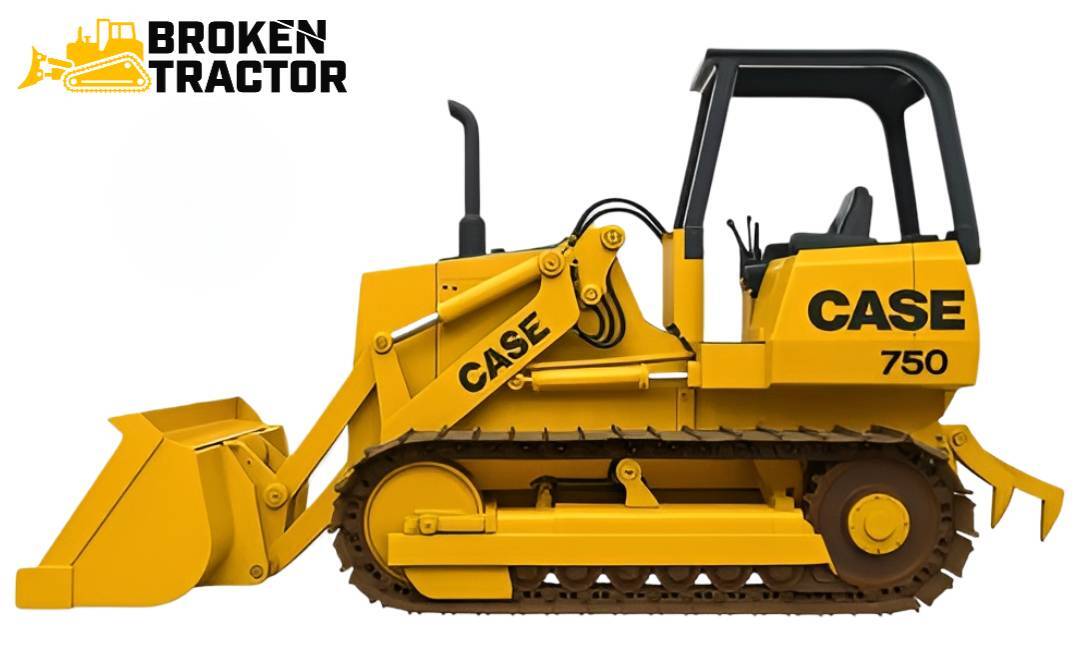
The Case 750 Crawler Dozer is the original mid-large frame Case crawler dozer, produced through the 1970s and early 1980s. The 750 sits between the Case 650 (mid-frame, smaller) and the Case 850 (mid-large, slightly bigger) in the Case construction dozer line of that era. As one machine in a multi-generation 750 family (750, 750B, 750C, 750H, 750K, 750L, 750M), the original 750 set the chassis pattern that the later 750B and 750C refined before the substantially redesigned 750H arrived in 2000.
At-a-glance specifications
Case 750 (original) - factory specifications
- Production era
- 1970s - early 1980s (original 750)
- Successor
- Case 750B (early 1980s)
- Engine
- Case 4-cylinder diesel (configuration varies by year)
- Power class
- ~80 - 95 horsepower flywheel
- Transmission
- Mechanical or power shift (option / year dependent)
- Hydraulics
- Open-center implement circuit
- Variants
- Standard, LGP (Low Ground Pressure)
- Operating weight
- ~19,000 - 22,000 lb depending on configuration
- Blade
- 6-way bulldozer blade - angle and tilt blade options
- Serial plate location
- Right side of operator's platform / chassis frame
Where the original 750 sits in the 750 family
- Case 750 (original) - 1970s-early 1980s, the machine documented in this spotlight. Case 4-cyl diesel, mechanical or power shift drivetrain.
- Case 750B - 1980s. Refresh with updated controls and accessory updates. (Separate spotlight pending.)
- Case 750C - later 1980s. Continued refinements; some 750C units offered turbocharged engine options. (Separate spotlight pending.)
- Case 750H - 2000-2003, hydrostatic dual-path drivetrain, Cummins B-series turbocharged engine. Substantial chassis and drivetrain redesign. See the Case 750H spotlight.
- Case 750K - Tier 4 Interim era, hydrostatic continuation. See the Case 750K spotlight.
- Case 750L - Tier 4 Final SCR/DEF. Separate spotlight pending.
- Case 750M - current-production. Separate spotlight pending.
Engine and powertrain
The original Case 750 used a Case 4-cylinder diesel engine. Exact engine designation and displacement varied across the production run as Case made running updates. Always confirm the engine plate before ordering engine-specific parts on a 750-era machine.
Transmission options included mechanical gear drive in early production and power shift configurations on later or higher-option units. Power shift made the 750 more responsive in dozing operations where direction changes are frequent.
Undercarriage
The 750-class undercarriage shares some component heritage with the 650 below and 850 above in the original Case mid-frame lineup. Sprocket bolt patterns, idler geometries, and master pin dimensions cross-fit on multiple components - confirm by part number against your serial. Roller and idler bushings are routine wear items at production-run age (40-plus years), and most field-service 750s have seen at least one full undercarriage rebuild.
Browse the Case Dozer Parts hub for current 750-era undercarriage availability.
Blade system and hydraulics
The 750 ships with a 6-way bulldozer blade - angle and tilt control hydraulically actuated. Blade cylinders, blade-carrier slider blocks, and cutting edges are all routine service items. Cutting edge replacement is generally needed every few hundred to few thousand hours of dozing depending on material and operator habit.
Hydraulic implement-circuit pressure is moderate by modern standards - open-center hydraulic systems were standard in this era. Seal kit availability for the blade cylinders is generally good, with aftermarket kits supporting most 750-era cylinder dimensions.
Common service items on a 40-year-old original 750
Engine accessory aging
Water pump, alternator, starter, and injection pump are all routinely rebuilt or replaced over a 750's service life. Cooling system service (radiator core flush or replacement, fan belt, hose set) is a routine maintenance milestone.
Hydraulic seal failure
Blade cylinder seal failures are common at this age. Cylinder rod chrome corrosion and seal weep are typical symptoms. Seal kit rebuilds address most cases; severe rod corrosion requires rod replacement.
Undercarriage replacement cycles
Track chains, rollers, idlers, and sprockets all have measurable wear lives. Modern aftermarket undercarriage is available for the 750 family.
Operator station and ROPS
Cab and canopy hardware, seat cushion replacement, and floorboard wear are typical aging-machine issues. ROPS structural integrity should be verified before resale.
Wiring and electrical
40-year-old wiring harnesses are routinely brittle. Hard starts, intermittent gauges, and dim lights are often traced to harness corrosion or insulation failure rather than the underlying component.
Cross-fit notes for the original 750
Parts on the original 750 family can cross-fit with both the 650 family (smaller-class) on some master pins and roller dimensions, and the 850 family (larger-class) on some idler bushings and blade-carrier hardware. The cross-fit is generally less broad than the H-generation cross-fits (where multiple sizes share documented parts like the 117835A1 slider block or the 359121A1 suspension seat). Confirm by part number against your serial before ordering.
Parts and cross-fit components
| Component area | What to look for | Notes |
|---|---|---|
| Sprockets & segments | Track sprocket assemblies, bolt-on segments | Some 750-era sprockets cross-fit the 650 and 850 families on shared bolt patterns. |
| Idlers & rollers | Front idler assemblies, top and bottom roller sets | Idler and roller bushings see mid-class crawler cross-fit. |
| Track recoil & adjusters | Recoil spring, adjuster yoke, chrome rod | Confirm by serial - running production changes apply. |
| Master pins | Track master pin and bushing | Master pins frequently share geometry across mid-class Case dozers. |
| Cutting edges & end bits | Standard and severe-duty cutting edges, end bits | Aftermarket cutting edges widely available. |
| Blade cylinder seal kits | Angle, tilt, lift cylinder seal kits | Confirm cylinder dimensions before ordering. |
| Engine accessory parts | Water pump, alternator, starter, fuel injection | Case 4-cyl diesel accessories share parts with other Case industrial 4-cyl applications. |
| Radiators & cooling | Radiator cores, fan belts, hose sets | Aftermarket radiator and cooling cross-fit available. |
| Filter service kits | Engine oil, fuel, air, hydraulic filter sets | Filter kits packaged by application speed routine service. |
| Operator seat | Universal industrial seat with mount kit | Universal Case industrial seats fit the 750 operator station with standard mount kits. |
For 750-era parts inventory and cross-fit confirmation, browse the Case Dozer Parts hub or contact our parts desk directly.
Working on a Case 750?
The original 750 is a 40-plus-year-old machine - year and serial dictate which parts fit. Our specialists can verify fitment by serial and walk you through the 750 family's cross-fit options.
Mon - Fri, 7:00 AM - 5:00 PM CT
Request a PartWhy the original 750 is still in service
The 750 sits in a sweet spot for mid-large dozer work - bigger than a 650 for pushing power but smaller and easier to transport than an 850 or 1150. For agricultural site prep, commercial dirt work, private road maintenance, and land-clearing, a 750 in good mechanical condition remains a productive machine. The mechanical and power shift drivetrains are also simpler to troubleshoot in the field than the hydrostatic systems on the later 750H and 750K.