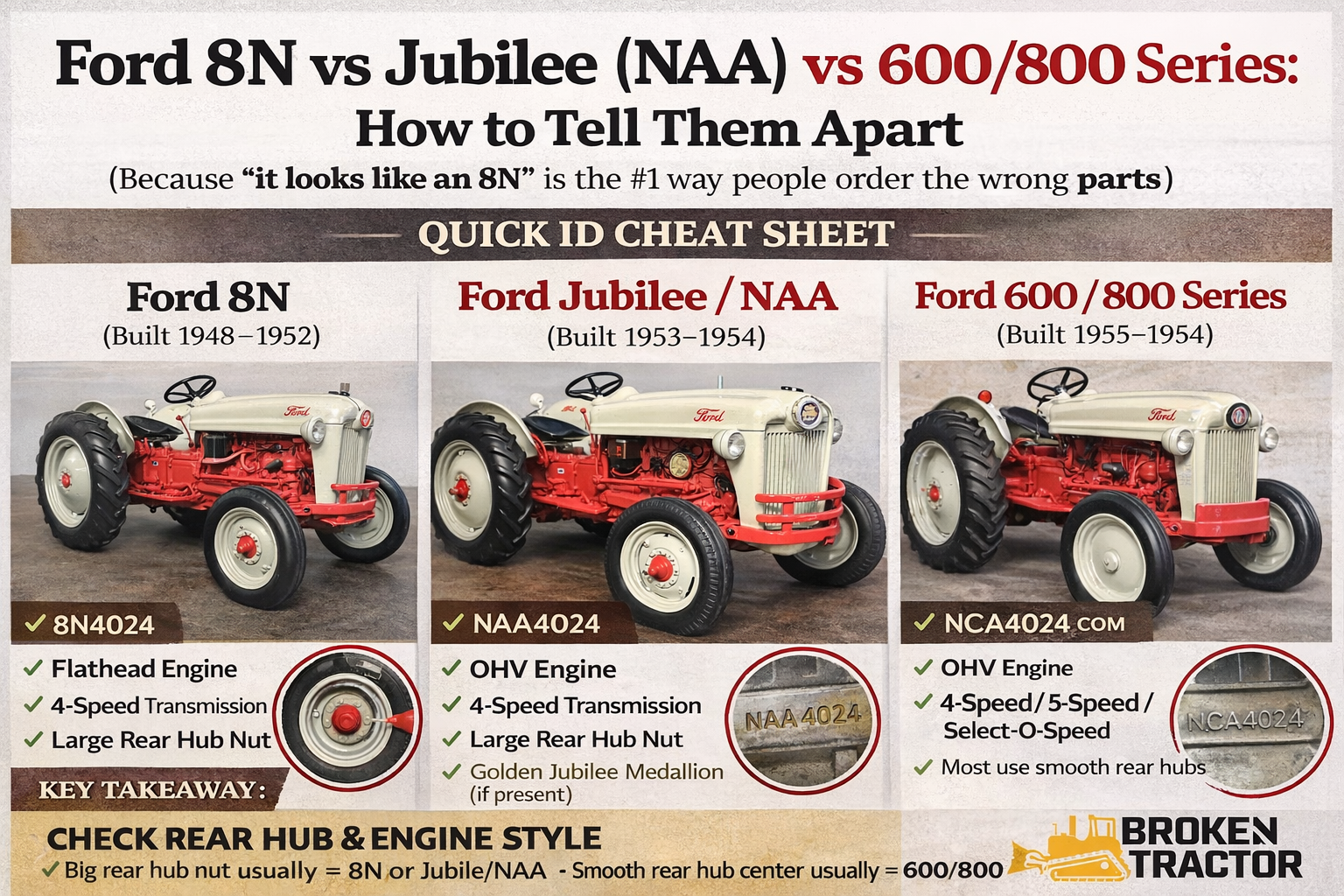
Ford 8N vs Jubilee (NAA) vs 600/800 Series: How to Tell Them Apart
Posted by Broken Tractor on Feb 18th 2026
(Because “it looks like an 8N” is the #1 way people order the wrong parts)
If you’ve ever tried ordering parts for an older Ford tractor, you’ve probably said something like:
-
“I think it’s an 8N…”
-
“It’s a Jubilee, I’m pretty sure…”
-
“It’s a 600 or 800… not sure which.”
And that’s exactly how wrong parts orders happen.
The good news:
-
You don’t need to be a tractor historian to identify these models.
-
You just need a few quick visual checks that are easy to spot in the driveway.
This guide covers the most common “look-alike” classics:
-
Ford 8N (1948–1952)
-
Ford Jubilee / NAA (1953–1954)
-
Ford 600 & 800 series (1955–1964)
The fastest way to tell them apart (60 seconds, no tools)
Step 1: Look at the rear wheel hub center
This is one of the best “walk-up” checks.
-
✅ 8N and Jubilee/NAA:
-
Large center nut visible in the middle of the rear hub.
-
-
✅ 600/800 series (’55 and newer):
-
Rear hub center is typically smooth (no big center nut like the earlier tractors).
-
If you remember only one thing, remember this:
-
Big center hub nut usually means 8N or Jubilee/NAA.
-
Smooth hub usually means 600/800.
Step 2: Check the engine style (this matters for parts)
These tractors didn’t just change cosmetics — Ford changed the engine design too.
-
✅ Ford 8N:
-
Flathead engine (flat cylinder head with valves in the block)
-
-
✅ Jubilee/NAA and 600/800 series:
-
Overhead valve (OHV) cylinder head
-
Practical tip:
-
If you’re buying engine parts (head gasket, valves, manifolds, ignition pieces), this check instantly narrows the field.
Step 3: Find the rear housing casting number (the “tattoo” on the tractor)
Casting numbers are like a built-in ID badge. On these models, the rear housing casting numbers often start like:
-
8N: 8N4024
-
Jubilee / NAA: NAA4024
-
600/800 series: NCA4024 or NDA4024
This is especially helpful when:
-
The tractor has been repainted
-
The emblems are missing
-
Someone swapped sheet metal over the years
Quick ID cheat sheet (simple + useful)
Ford 8N (Built 1948–1952)
What it’s known for:
-
Classic, simple
-
Parts are everywhere
-
Huge support community
Engine:
-
Flathead (valves in block)
Transmission:
-
4-speed
Clutch:
-
Single-stage
Rear hub:
-
Large center nut
Common casting clue:
-
8N4024
Common parts people shop for:
-
Ignition tune-up parts
-
Hydraulic top cover parts
-
PTO seals
-
Brakes
-
Steering
-
Carb kits
-
Clutch parts
Ford Jubilee / NAA (Built 1953–1954)
What it’s known for:
-
The “bridge” between the N-series and Hundred series
-
Modernized feel compared to 8N
Engine:
-
OHV (overhead valve)
Transmission:
-
4-speed
Clutch:
-
Single-stage
Rear hub:
-
Large center nut
Common casting clue:
-
NAA4024
Easy visual clue often mentioned:
-
“Golden Jubilee” badging/medallion (when present)
Common parts people shop for:
-
Hydraulics upgrades/repairs
-
Engine gaskets
-
Carb kits
-
Ignition
-
Clutch
-
Steering components
Ford 600 / 800 Series (Built 1955–1964)
What it’s known for:
-
More options
-
More power choices
-
Multiple transmissions
-
Lots of “sub-model” variations
Engine:
-
OHV
Rear hub:
-
Typically smooth center (no big hub nut like earlier)
Transmission/clutch options:
-
4-speed (single-stage clutch)
-
5-speed (single-stage clutch)
-
5-speed (dual-stage clutch for live PTO on some models)
-
Select-O-Speed (some models)
Common casting clues:
-
NCA4024
-
NDA4024
Common parts people shop for:
-
Live PTO-related parts
-
Hydraulic lift components
-
Brakes
-
Steering
-
Clutch
-
Seals
-
Transmission-related service items
The #1 reason people still get it wrong: “It looks like mine”
Here’s the hard truth:
-
On older tractors, sheet metal and badges get swapped all the time.
-
Owners replace hoods, grills, and fenders after decades of work.
-
Some tractors are repainted and “rebadged.”
-
Some have engine swaps.
That’s why we like the checks that don’t lie:
-
Rear hub style
-
Engine type (flathead vs OHV)
-
Casting numbers
-
Transmission options
Those are your best “truth tellers” for ordering parts.
A practical “Parts Buyer” checklist (use this before ordering)
When you’re about to buy parts, grab:
-
Your model ID using the steps above
-
A few photos (left side, right side, rear hub, engine area)
-
Casting number if you can find it
-
If buying drivetrain parts: note your transmission type (4-speed, 5-speed, SOS)
That little bit of info prevents the most common headache:
-
Buying the right part for the wrong tractor.
Shop Our Parts
Broken Tractor carries thousands of hard-to-find parts for Case, John Deere, Ford, Kubota, Caterpillar, and more. If we don't have it listed, we'll find it.
Stay in the Loop
Get parts tips, repair guides, and new arrivals from Broken Tractor delivered to your inbox.



