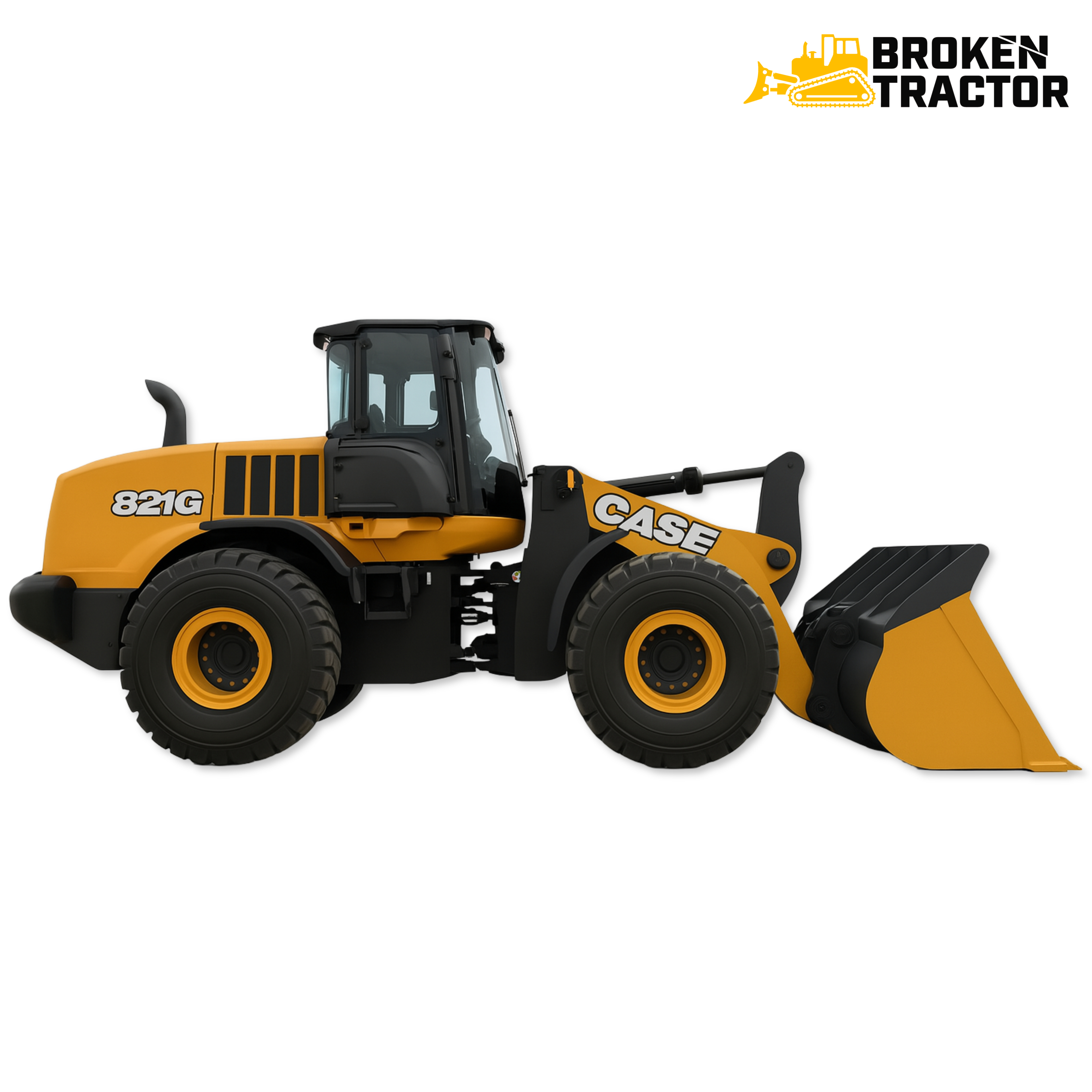
Case 821G Wheel Loader: Current G-Generation Tier 4 Final Production Loader
The 821G is Case's current production-class wheel loader at the 821 size - Tier 4 Final emissions with full DPF, DEF, and SCR aftertreatment, power-shift transmission, and the G-series cab. It is the direct successor to the 821F and shares its drivetrain and hydraulic architecture with the 621G, 721G, and 921G.
Where the 821G fits in the Case wheel loader line
The 821G is the current production version of Case's 821-size platform - the direct successor to the 821F. In the G-generation family it sits between the smaller 721G and the larger 921G, all sharing the same Tier 4 Final powertrain architecture and G-series cab.
The 821G is articulated-frame with a power-shift transmission and a hydraulic loader linkage. The Tier 4 Final Case diesel runs full aftertreatment - diesel particulate filter (DPF), diesel exhaust fluid (DEF) dosing, and selective catalytic reduction (SCR) catalyst - to meet current emissions standards. The G-series cab introduced refined operator controls, improved climate, and a full-color monitor display showing engine, drive, hydraulic, and aftertreatment system status.
Case 821G Wheel Loader - Quick Specs
- Production
- 2017 - Current
- Class
- Production Wheel Loader
- Generation
- G-Series
- Frame
- Articulated
- Drivetrain
- Power Shift
- Engine
- Tier 4 Final Case Diesel
- Aftertreatment
- DPF + DEF + SCR
- Front Tool
- Hydraulic Loader
- Serial Plate
- Left Side Frame at Articulation Joint
- Predecessor
- Case 821F
What changed from the 821F to the 821G
- Emissions tier. The 821G moved to full Tier 4 Final - DPF, DEF, and SCR. The 821F was Tier 4 Interim on most build dates, with simpler aftertreatment. DEF dosing and NOx sensor service are new requirements on the G.
- Cab and controls. G-series operator station with improved climate, refined joystick controls on equipped configurations, full-color monitor display, and integrated telematics.
- Electronics. Updated engine ECU and aftertreatment control modules. More sensor coverage across the engine and exhaust system.
- Hydraulics. Refined electrohydraulic control valve calibration and updated piston-pump variant.
- Driveline. Power-shift transmission carried forward with refined shift mapping; axles and planetary final drives share family lineage with prior F-series.
Engine, hydraulics, and drivetrain
The 821G runs a Tier 4 Final Case diesel through a power-shift transmission. The engine is common-rail with electronic injectors, cooled EGR, DPF for particulate control, and SCR catalyst with DEF dosing for NOx control. Clean fuel and clean DEF are the two highest-leverage maintenance items on this platform - common-rail injectors do not tolerate contamination and SCR catalysts are damaged by poor-quality DEF.
Hydraulics use a variable-displacement piston pump feeding electrohydraulic control valves to the loader cylinders and articulation steering circuit. The articulation steering cylinders pivot the front frame against the rear frame for steering - G109152 steering cylinder bushing is a known cross-fit item for the 521F/621/721/821 series. The drivetrain carries power-shift transmission output through driveshafts to front and rear axles with planetary final drives and wet-disc service brakes.
Common service items on the 821G
- Aftertreatment: DPF service, DEF tank and dosing module, SCR catalyst, NOx sensors, DPF differential pressure sensor, EGR cooler.
- Engine internals: Case Tier 4 Final diesel pistons, rings, sleeves, bearings, gaskets. R49482 engine motor mount is a recurring service item.
- Fuel system: Common-rail injectors, high-pressure pump, lift pump, water separator, tight fuel filtration.
- Cooling system: Radiator, water pump, thermostat, fan, charge-air cooler, hoses, belts.
- Loader hydraulics: Cylinder seal kits, piston-pump rebuilds, electrohydraulic control valves, hoses, fittings.
- Articulation steering: Steering cylinder seal kits, articulation pivot pins and bushings. G109152 bushing fits 521F, 621, 721, 821 series.
- Loader components: Bucket teeth, cutting edges, pins, bushings, quick coupler.
- Drivetrain: Power-shift clutch packs, transmission service, driveshafts, axle seals, planetary final drives. Transmission shift lever assembly for control service.
- Brakes: Wet-disc service brakes - S300718 brake shoe, A12985 slave cylinder, and N8695 master cylinder are recurring items across the wheel loader family.
- Electrical / ECU: Engine ECU, aftertreatment control module, instrument cluster, sensors, wiring harness, telematics module. 87528688 AC blower speed resistor cross-fits 521E through 1121F.
- Cab / climate: Seat, gauges, control levers, glass, weather seals, A/C compressor. 47880728 cab fresh-air filter on cab-equipped units.
Parts we carry for the Case 821G
| Category | Common Parts | Browse |
|---|---|---|
| Aftertreatment | DPF, DEF, SCR, NOx sensors, EGR | Browse Aftertreatment |
| Engine | Tier 4 Final diesel internals, mounts | R49482 Engine Mount |
| Fuel System | Common-rail injectors, HP pump, lift pump, filters | Browse Fuel System |
| Cooling | Radiator, water pump, charge-air cooler, hoses | Browse Cooling |
| Loader Hydraulics | Piston pump, cylinders, seal kits, valves | Browse Hydraulics |
| Articulation Steering | G109152 bushing, pivot pins, cylinder seals | G109152 Bushing |
| Loader Components | Bucket teeth, cutting edges, pins, bushings | Browse Loader Components |
| Drivetrain | Power-shift clutch packs, shift lever, axles | Shift Lever Assembly |
| Brakes | S300718 shoe, A12985 slave, N8695 master | S300718 Brake Shoe |
| Electrical | ECU, sensors, harness, telematics, switches | Browse Electrical |
| Cab / Climate | 87528688 blower resistor, 47880728 cab filter | 87528688 Blower Resistor |
Need a part for your Case 821G Wheel Loader?
Aftertreatment components, common-rail fuel system, and power-shift driveline are the highest-value items on a 821G. Call our parts team with your serial number and we’ll match the right component to your machine.
Request a PartWhat to verify before ordering
- Generation matters. The 821-series spans multiple generations (821, 821B, 821C, 821E, 821F, 821G). Confirm by serial before ordering.
- Serial number. The 821G has had running changes - match parts to the machine serial on the left frame at the articulation joint.
- Engine serial. Case diesel internal parts must match the engine serial number.
- Aftertreatment configuration. DPF and SCR part numbers vary across the production run. Confirm against the aftertreatment serial tag.
- Cab vs. ROPS canopy. Operator station equipment varied by configuration.
- Tire / rim spec. Confirm rim diameter and bolt pattern before ordering tire or rim parts.
Why the 821G still earns a paycheck
The 821G is Case's current production-class wheel loader at the 821 size. It is the platform a customer buying new from a Case dealer today is taking delivery of, which means it is the configuration that will be running in production fleets for the next decade-plus. The G-series powertrain, hydraulics, and cab are mature - the platform inherited a well-understood power-shift drivetrain and a hydraulic architecture proven across the 521G, 621G, 721G, and 921G siblings.
Maintenance priorities on a 821G: clean fuel for the common-rail injection system, quality DEF for the SCR catalyst, DPF service per the Case schedule, hydraulic oil condition, brake service on the wet-disc circuit, and articulation pivot inspection. Parts coverage is strong across the G-series family because so many components cross-fit between the 521G/621G/721G/821G/921G platforms.