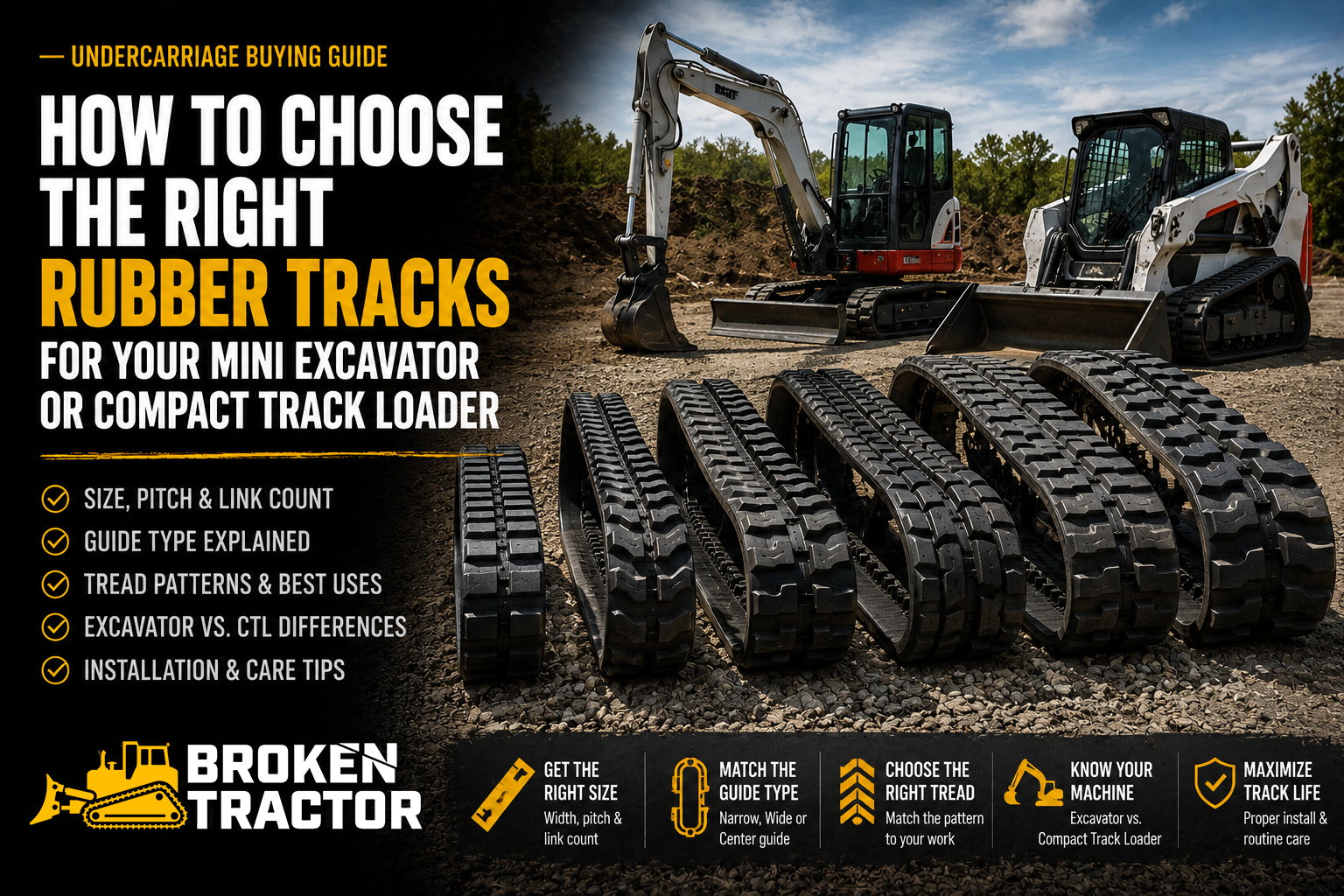
How to Choose the Right Rubber Tracks for Your Mini Excavator or Compact Track Loader
Posted by Broken Tractor on May 19th 2026
Picking rubber tracks is more than matching the brand on the side of your machine. Width, pitch, link count, guide type, and tread pattern all have to line up — and getting one wrong is the difference between 1,500 hours of solid service and an undercarriage tearing itself apart in 500. Here's how to get it right the first time. If you've spent any time on heavy equipment forums, you've seen the conversation. A contractor pulls a fresh set of aftermarket tracks at 500 hours, badly cracked, while the operator next to him is still running OEM Bridgestones at 1,200 hours with life left. Same machine, same jobsite, completely different result. The difference usually isn't the brand on the box — it's whether the buyer matched the right specifications to the right work. This guide walks through the five things every operator should check before ordering rubber tracks: the size, the guide type, the tread pattern, the work the machine actually does, and a few install-and-care fundamentals that make the difference between 600 hours of life and 1,500. We carry rubber tracks for nearly every major mini excavator and compact track loader on the market — over 300 fitments across Bobcat, Kubota, Case, John Deere, Takeuchi, Caterpillar, Komatsu, JCB, Hitachi, Yanmar, Wacker Neuson, Volvo, Gehl, IHI, Kobelco, Doosan, Hyundai, and more — so the goal here is to help you order the right one, not just any one. Every rubber track is described by five characteristics. The first four are dimensional — they decide whether the track will physically fit on the machine. The fifth is about the work the track does once it's on. Get the first four wrong and the track won't run; get the fifth wrong and the track will run but it'll wear out fast or chew up your worksite. The first three are usually written together as a sizing code: 450×86×56 means a 450mm wide track with 86mm pitch and 56 links. That code lives on the inside surface of the track, stamped or molded into the rubber. If your old track is destroyed or the stamp is worn off, you can measure those three numbers manually with a tape measure and a chalk mark. This is the easy one. Lay a tape measure across the face of the track from edge to edge — that's your width, in millimeters. Common widths run from 180mm on the smallest micro-excavators all the way up to 500mm+ on full-size compact track loaders. A few benchmarks: Wider tracks spread the machine's weight over more ground — better flotation on soft soil, less ground pressure, less rutting. Narrower tracks maneuver better in tight spaces and run quieter on hard surfaces. You don't get to choose this for your machine; it's determined by the undercarriage. But knowing what width the machine takes is the first specification to confirm. Pitch is the center-to-center distance between two adjacent drive lugs (the metal teeth on the inside of the track that engage with the sprocket). To measure, count 10 lugs, measure that total distance, and divide by 10 — averaging across multiple lugs is more accurate than measuring just one pair. Common pitches are 52.5mm, 72mm, 72.5mm, 84mm, 86mm, and 96mm. Pitch is the single most critical dimension for sprocket compatibility — if the pitch is wrong by even a few millimeters, the sprocket teeth won't engage cleanly. The track skips, slips, and accelerates wear on both the track and the sprocket itself. The third number is simply how many drive lugs are around the full loop of the track. Mark a starting lug with chalk, rotate the track, and count every lug until you return to the mark. Small mini-ex tracks may have 32–40 links; large CTL tracks run 55–60 or higher. The link count determines the track's overall length — too few and the undercarriage tensioner won't take up the slack, too many and the track will hang loose. This is where most ordering mistakes happen. After the width × pitch × links code, many tracks have a letter appended — like 300×52.5N×84 or 400×72.5W×74. That letter is the guide type, and it describes how the internal guides on the track are shaped. An 84N track and an 84W track have the exact same width, pitch, and link count — but the guides are positioned differently. Put a W-guide track on an N-guide undercarriage and it'll de-track the first time it works in a rut. If your old track is worn out and the guide letter is no longer legible, this is the spec to verify against your machine's serial number rather than guess from the wreckage. Once the dimensions are settled, tread pattern is what makes the track work well for your job. The big patterns you'll see in our catalog and across the industry: If you're not sure where to start, C-pattern is the safe answer for most work. It's the pattern that came on your machine from the factory, it handles mixed terrain, and it's available in nearly every size we stock. Most of our top-selling tracks across Bobcat, Kubota, Case, John Deere, JCB, IHI, Gehl, Takeuchi, Komatsu, and Yanmar are C-pattern in 320mm or 450mm width. One important distinction: tread pattern matters far more on a compact track loader than on a mini excavator, and the reason is simple physics. A mini excavator drives to the work area, sets the stabilizer blade, and digs. The tracks are mostly stationary while the machine is under load. A compact track loader is different — it's pushing, pulling, lifting, and turning while moving, often under heavy load. The tracks are doing aggressive work every minute the machine is running. That means tread pattern, edge count, and self-cleaning all matter much more on a CTL than on a mini excavator of the same size. For mini excavators, most operators are fine with the standard C-pattern or short-pitch track in the correct size. For compact track loaders, it's worth thinking about the work: Track life depends on the work more than anything else. The industry-typical range for rubber tracks on a well-maintained machine is roughly 1,000 to 1,600 operating hours. Operators on heavy-equipment forums report a wide spread around those numbers — some experiences from real users: The variables that move those numbers up or down: ground conditions (rocky and abrasive shortens life dramatically), operator habits (sharp turns chew rubber fast), undercarriage condition (worn rollers and idlers eat tracks alive), and track quality (the carcass construction and rubber compound matter more than the price tag suggests). Broken Tractor stocks rubber tracks across every major mini excavator and compact track loader brand. Pick your brand below to see the full lineup, or call our team at (800) 909-7060 with your machine model and serial number — we'll match the right track to your application. The single biggest variable in how long a rubber track lasts isn't the brand on the box — it's how the operator treats the machine. A few habits separate operators who get 1,500 hours from operators who get 600: The right rubber tracks, ordered correctly, on a machine with a sound undercarriage, run quietly and last. The wrong tracks — wrong size, wrong guide, wrong tread for the work — fail fast no matter how much you paid for them. A few minutes of measurement up front saves a few thousand dollars of regret later. Over 300 fitments across Bobcat, Kubota, Case, John Deere, Takeuchi, Cat, Komatsu, JCB, Hitachi, Yanmar, Wacker Neuson, Volvo, Gehl, IHI, Kobelco, Doosan, Hyundai, and more. Fast LTL freight shipping from a U.S.-based parts team that can verify fitment before your order ships.The five things that actually have to match
Reading the size code: width × pitch × links
Width
Pitch
Link count
Guide type — the letter that ruins orders
Letter
Guide type
Typical use
N
Narrow / offset single guide
Common on smaller mini excavators
K
Komatsu-style — same as N, used interchangeably
Smaller excavators, some Komatsu
W
Wide center guide
Common on larger mini excavators
B
Block-style guides on both sides of the drive path
Most compact track loaders
T
Takeuchi-specific guide configuration
Many Takeuchi mini excavators
Tread pattern: matching tread to job
Pattern
Best for
Weaknesses
C-pattern / C-lug
General use — dirt, clay, mud, light pavement, mixed terrain. The most common pattern; what you get from the factory on most machines
Not the longest life on hard, abrasive surfaces. Not the deepest traction in heavy mud
Block / staggered block
All-purpose tread that's hard to beat on asphalt, concrete, and packed surfaces. Smooth ride, good wear life
Less aggressive grip in deep mud or snow
Zig-zag / Z-pattern
Maximum traction in mud, sand, snow, and slick clay. Best self-cleaning of any pattern
Wears fast on pavement and rocky surfaces — not a hard-surface tread
Multi-bar
Paved and finished surfaces — landscaping, finished grade, work where you can't damage the ground
Less traction in mud or loose soil
Straight bar
Mud and wet conditions, with a softer compound that's gentler on finished turf
Wears faster than harder block-style patterns
Short pitch
Smoother ride and lower vibration — the metal lugs engage each sprocket tooth one-for-one
Typically slightly more expensive than long-pitch alternatives
Mini excavator vs. compact track loader (the difference matters)
What you can realistically expect for lifespan
Quick fitment by brand
Compact track loaders
Mini excavators
Installation and care: getting the full life from your tracks
Need rubber tracks for your machine?