
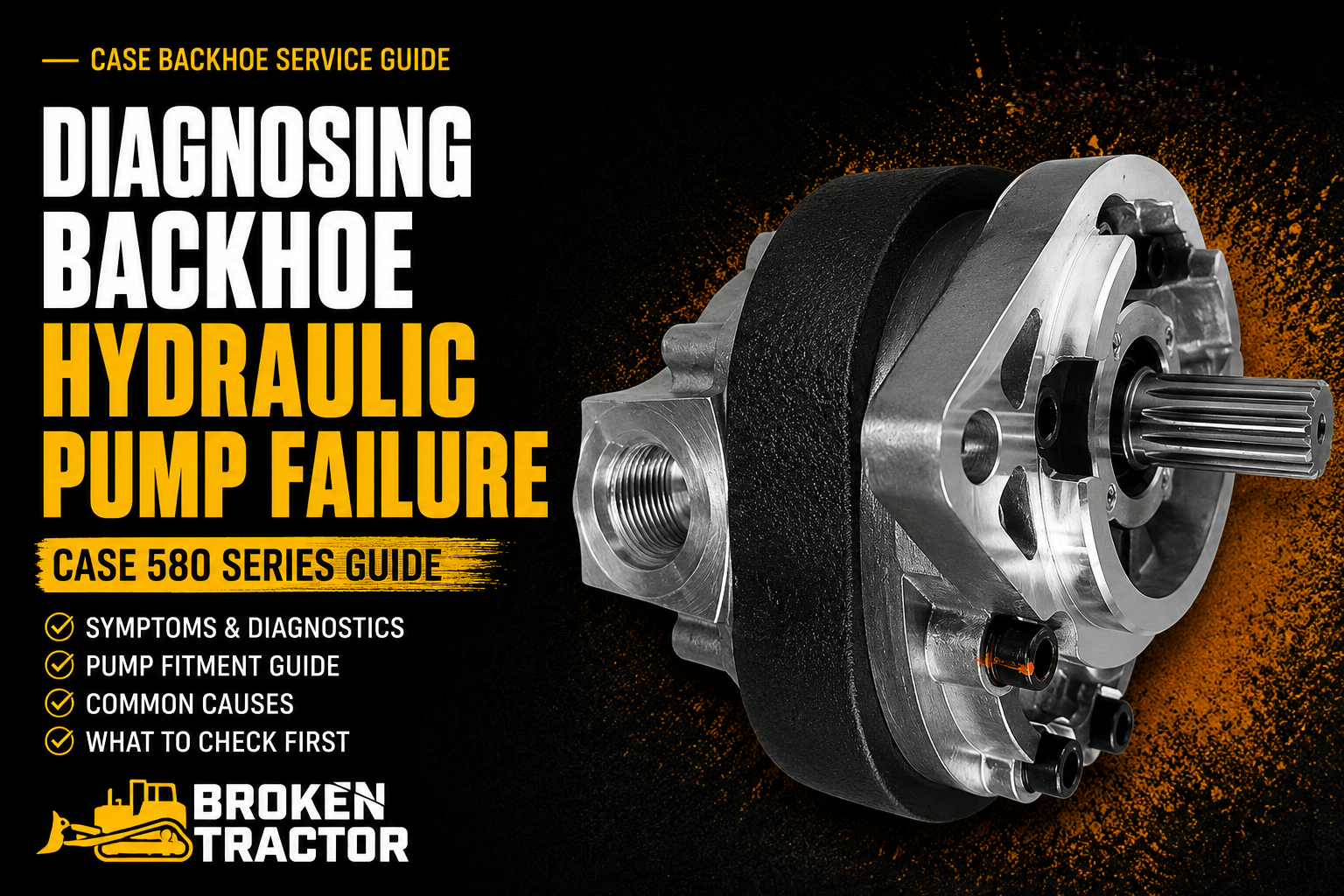
Diagnosing Backhoe Hydraulic Pump Failure on a Case 580
Posted by Broken Tractor on May 19th 2026
Strong when you start the morning, then weak by lunchtime. If your Case 580 has plenty of lift on a cold pump and loses it as the hydraulic oil warms up, you're looking at one of the most predictable failures on this machine. Here's how to confirm it's the pump, what's actually happening inside the housing, and how to pick the right replacement the first time. Talk to anyone who's run a Case 580 for a few thousand hours and the symptom will sound familiar. The machine starts the day strong. The loader lifts a full bucket without complaint, the dipper pulls hard, the boom swings clean. Two hours in, the oil is hot, and suddenly the same machine is bogging on lifts it handled cold. By afternoon, the boom drifts down on its own when you stop, the loader struggles to break a pile, and the operator is wondering whether it's the pump, the cylinders, or "something in the valve." It's almost always the pump. And the reason it's almost always the pump is mechanical and predictable. This guide walks the full diagnosis: how to confirm a worn hydraulic pump before you spend money replacing one, what's actually wearing out inside the housing, how to identify the correct replacement for your specific 580 series, and the one component every operator should inspect before bolting on a new pump. The first time you notice it, you'll probably blame the operator, the temperature, or the load. The machine worked yesterday morning. It works this morning. By midday it's a different machine. The pattern is so consistent it's almost a fingerprint: That cold-strong, hot-weak signature is the single most reliable indicator of a worn main hydraulic pump on a Case 580. Internal valve leaks, cylinder seal failures, and relief valve issues can all cause weak hydraulics — but they don't typically reverse themselves when the machine cools down. Pump bypass does, and the reason is straightforward physics. Inside a Case 580 main hydraulic pump, a set of pistons or gears moves hydraulic fluid against a precisely machined housing surface. The clearance between those moving parts and the housing is tight on purpose — it's what lets the pump build pressure instead of just stirring the oil. New from the factory, the clearance is small enough that even thin, hot oil can't slip past in any meaningful quantity. Over years of use, two things happen at the same time. The housing wall wears, opening up that clearance. And the pistons (or gear faces, depending on the pump design) wear at their sealing edges. Neither is catastrophic on its own. The pump still pumps. It still builds pressure cold, when the hydraulic oil is thick enough to bridge the gap. Then the oil warms up. Hydraulic fluid loses viscosity dramatically with temperature — by some industry estimates, the viscosity at 180°F is roughly a third of what it is at 80°F. That thinner oil can now slip through the worn clearance and bypass the pistons internally instead of being pushed out under pressure. The pump is still turning. It's just not moving the same volume of oil out to the cylinders, because a meaningful fraction of each stroke is leaking back inside the housing. That's the bypass mechanism in one paragraph. Cold oil is thick enough to mask wear. Hot oil isn't. The pump didn't "fail" suddenly — it has been wearing for thousands of hours and just crossed the threshold where thin oil reveals it. A few other failures mimic the warm-bypass pattern partially. Before you order a pump, rule these out: You don't need a flow meter to get a reasonable read on pump condition. A few simple in-the-yard tests narrow it down before you bring out gauges: First thing in the morning, with the oil cold, run a full lift cycle on the loader with a moderate load. Time it. Note how the engine sounds — any bog, any whine. Then work the machine for an hour or two until the oil is hot to the touch on the reservoir. Run the same lift cycle with the same load. If the hot cycle is noticeably slower or the engine bogs harder, you've reproduced the classic pump-wear signature. Lift the loader to full height with a moderate load, set the parking brake, kill the engine, and watch the loader for two minutes. Some drift is normal — significant drift (more than an inch or two in that time) usually points to a cylinder or control valve, not the pump. Use this test to rule out cylinder leaks before blaming the pump. With the machine warm, try to lift the loader while curling the bucket at the same time. A healthy pump and reservoir should support both at slightly reduced speed. A weak pump will visibly stall one function or both, often with the engine pulling down hard. This test is informal but it's how most experienced operators sniff out marginal pumps. A 3,000 PSI hydraulic test gauge and a couple of fittings is all you need for a definitive answer. The exact test port varies by series, but on most 580 backhoes you can tee a gauge into the line between the pump and the loader control valve, or use a designated test port on the loader valve itself. These are working approximations. Always confirm the exact spec in your machine's service manual before condemning anything — there are variations by build, sub-series, and configuration. Run the test at full engine RPM with the oil hot, deadhead a function (hold the lift fully up against its stop, for example, to load the relief valve), and read the gauge. If the reading is well below the target and the pump is otherwise free of suction problems, you've confirmed the pump. Case used several different hydraulic pump designs across four decades of 580 production. Pumps from one series do not bolt to another in most cases — input shaft splines, mounting bolt patterns, flow rates, and port configurations all changed. The right pump for your machine depends on which series and sub-series you have. If you're not sure which series your machine is, the Case 580 serial number guide walks you through identifying it from the serial number plate. Once you know the series, the pump selection is straightforward. The D48950 is the classic Webster-style pump fitted to the earliest production 580 platforms — through the 580C era. It's a 13-spline input pump that also fits a wide range of Case dozers from the same generation (450 through 550). One of the most reliable indicators that this is the right pump for your machine is the spline count on the existing pump shaft: 13-spline puts you in this family. This pump fits the following machines: Order the Case Backhoe Hydraulic Pump D48950 direct — these are new pumps, not rebuilds, with a Webster-pattern that drops in clean. The matching D90883 13-spline flex coupler should be inspected and replaced any time the pump is out. The D series brought a redesigned pump. The D126580 is the main hydraulic pump for the D and E platforms — supplying flow for loader, backhoe, and power steering operation. It's a larger and heavier pump than the D48950 (30 lb versus 18) with one inlet and two outlets to support the combined steering-and-implement hydraulic circuit. Fitment covers all four D/E platform machines: The D126580 pump is matched to the D/E backhoe configuration and ships from a U.S. warehouse. Inspect the splines on the pump shaft and the flex coupler for wear before installation — installing a fresh pump onto a worn coupler is one of the most common ways to ruin a new pump in its first hundred hours. The Super L brought another redesigned pump. The 257954A1 is a 17-spline, 25-GPM unit that supplies the main hydraulic circuit on the Super L (all serial numbers) and the early Super M (Series I, before serial number JJG999999). It uses a different coupler than the earlier pumps — the 257948A1 — which is also 17-spline. Fitment: This is a heavier-flow pump than the earlier Webster-style designs, and it weighs nearly four times what a D48950 does — keep that in mind when planning the swap. The 257954A1 main hydraulic pump ships with the right configuration for the Super L/early Super M application. Plan to replace the 257948A1 pump coupler at the same time — the splines wear together, and putting a new pump on an old coupler invites a repeat failure. If your Super M is Series II or III (Iveco engine), the pump is different. Browse the full Case backhoe hydraulic pumps category to find the right unit for your machine. Motor mounts. Every time. This is the single most common reason a brand-new hydraulic pump fails inside its first year on a Case 580. The hydraulic pump on a Case 580 sits at the front of the engine, driven directly off the crankshaft through the flex coupler. The engine is supported on rubber motor mounts that absorb vibration. When those mounts collapse, sag, or break — and on a thirty-year-old machine, at least one of them probably has — the engine shifts slightly relative to the pump. That shift loads the pump shaft sideways instead of straight through, and the flex coupler can no longer compensate. The result is rapid wear on the pump shaft splines, on the coupler, and on the input shaft seal. A pump that should last 5,000 hours can be ruined in 500. Browse the full Case backhoe engine parts for motor mount options, including kits like the D122727 motor mount kit for D-series and similar applications, the 117844A1 mount kit for the L-series, and the 87488318 front mount kit for Iveco-powered Super M Series II and III machines. A few practices separate pump installs that last 5,000 hours from pump installs that fail in 500: A worn hydraulic pump is one of the most predictable failures on the Case 580 platform, and one of the most diagnosable. The cold-strong, hot-weak signature is so characteristic that experienced operators can call it without a gauge. With a pressure test and a flow comparison cold versus hot, you can confirm it without ambiguity. And with the right pump and the right motor mounts in the new install, the next 5,000 hours of work shouldn't see this problem again. D48950 for the 480B–580C, D126580 for the D and E series, 257954A1 for the Super L and early Super M, and the full lineup for every Case backhoe in between. Serial-number-verified fitment, new pumps (not rebuilds), and U.S. warehouse shipping.The classic symptom: strong cold, weak hot
Why a warm pump bypasses (the mechanical reality)
Confirming it's the pump and not something else
Symptom
Likely cause
How to tell
Weak across all functions, worse when hot
Worn main pump
Pressure test at the loader valve drops below spec when hot, climbs back when cold
Weak across all functions, same hot and cold
Main relief valve stuck or worn
Pressure won't climb to spec at any temperature
One cylinder slow or drifts, others fine
Cylinder seal failure or internal valve leak
Hold that function under load — if it slowly retracts on its own, it's the cylinder
Pump whines or cavitates, hot or cold
Restricted suction (collapsed hose, clogged screen)
Inspect suction line and reservoir screen; foam or aeration in the oil is a giveaway
Loss of forward only, reverse normal, worse when warm
Power shuttle clutches
This is a transmission issue, not a main pump issue — see the power shuttle, torque, pump and kits category
Field tests you can run without a flow meter
The cold-vs-hot comparison test
The drift test
The simultaneous-function test
Pressure-gauge testing: what numbers to look for
Approximate main relief pressure targets
Picking the right pump for your serial number
D48950 — 480B, 480C, 530CK, 580CK, 580B, 580C
D48950 — Quick specs
D126580 — 580D, 580 Super D, 580E, 580 Super E
D126580 — Quick specs
257954A1 — 580 Super L, 580 Super M Series I
257954A1 — Quick specs
The one thing to check before bolting on the new pump
Installation notes that save the new pump
Need a hydraulic pump for your Case 580?