
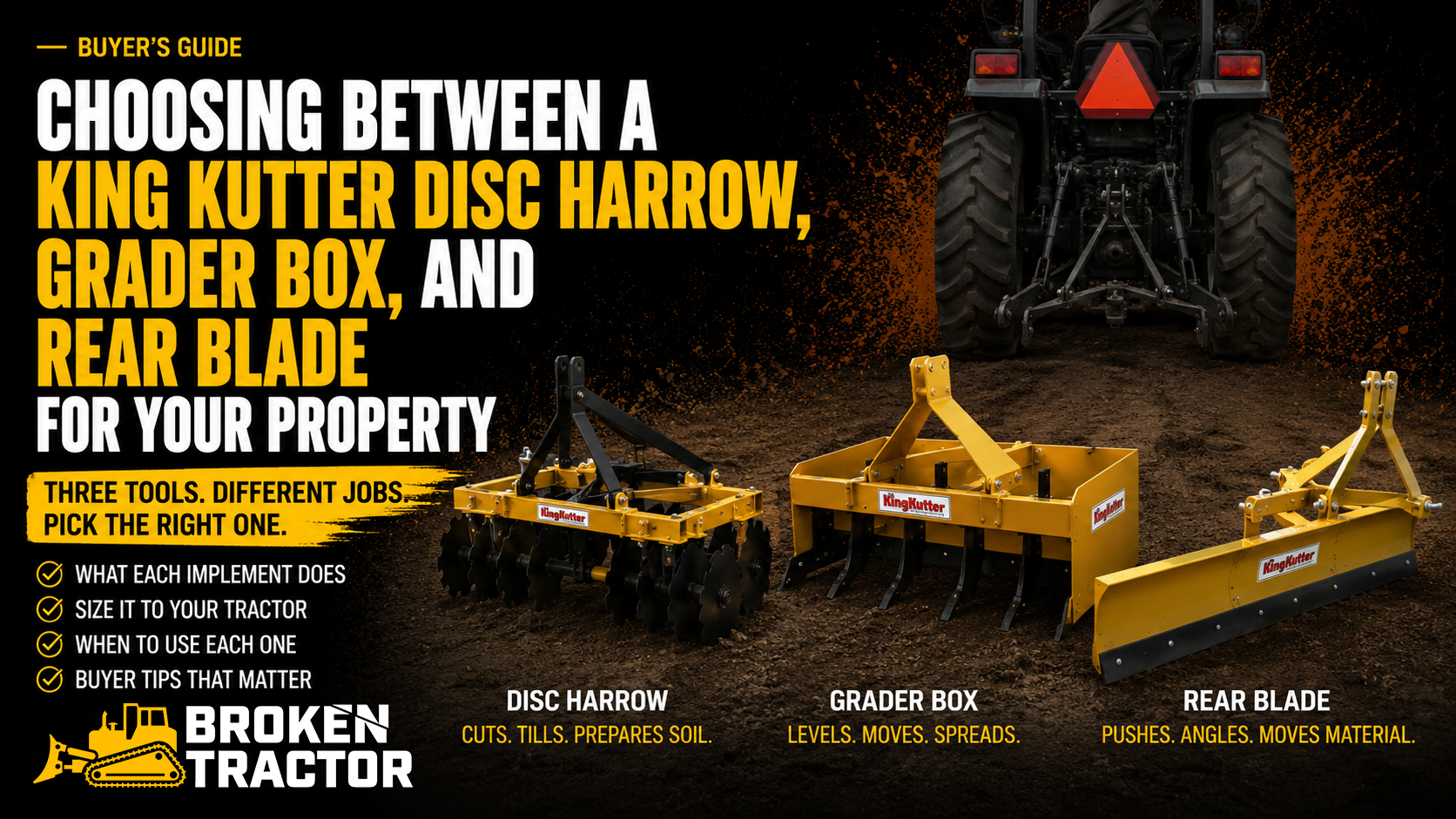
Choosing Between a King Kutter Disc Harrow, Grader Box, and Rear Blade for Your Property
Posted by Broken Tractor on May 19th 2026
Three implements that look similar in the catalog but solve completely different problems on the ground. Here's what each one actually does, how to size it to your tractor, and which one is right for the job you're trying to finish. If you've spent any time in a tractor supply store, you've seen all three. Disc harrow, grader box, rear blade. They're all priced in roughly the same range, they all hang off the back of a tractor on a three-point hitch, and they all promise to move dirt. So which one do you actually need? The answer depends on the job, not the implement. Each of these three tools does a specific thing well — and trying to use one for the wrong job is the fastest way to be unhappy with all of them. Here's how to figure out which one fits your property. A disc harrow is a soil engagement tool. Two rows of curved steel disc blades, mounted at an angle, that cut into the ground and turn the soil over as the tractor pulls it forward. The discs slice through grass, roots, and crop residue and mix the surface layer with the soil underneath. This is the implement you want when you're working soil — breaking up sod for a food plot, preparing a garden bed, tilling under last season's stalks, or mixing in lime or fertilizer before planting. It's not for moving dirt from one place to another. It's for cutting into dirt that's already there. King Kutter sells discs in two main configurations: Angle Frame Discs (the traditional X-pattern frame, generally lighter and more affordable) and Box Frame Discs (heavier, more rigid frame for tougher soil and bigger tractors). A grader box (sometimes called a box blade) is a soil-moving and leveling tool. A rectangular steel box with a cutting edge on the bottom front and rear, and a row of rippers — or shanks — that hang down from the bottom to break up hard ground ahead of the cutting edges. This is the implement you want for driveways, building pads, leveling rough ground, and pulling material from where there's too much to where there isn't enough. Drop the shanks to break up packed driveway gravel or compacted clay, then raise them and use the box itself to spread and level. It's the most versatile of the three for earth-moving work — and the one most landowners end up buying first if they have a long driveway. A rear blade is a single curved steel blade that mounts behind the tractor and can be angled left, right, or straight. Most King Kutter rear blades — including the standard, the HDRB heavy-duty, and the PRB Professional series — can also tilt and offset. The blade is built for pushing and pulling material into windrows, plowing snow, ditching, and grading driveways where you need to throw the material off to one side. The grader box is a "level it where it is" tool; the rear blade is a "move it from here to there" tool. Most people buying their first earth-moving implement know what they want to accomplish but aren't sure which tool fits. Here's the practical map: Notice that a single implement rarely covers every job. Landowners who do varied work often end up with two of the three over time — typically a grader box for driveway and pad work, plus either a disc for planting or a rear blade for snow and ditching. Buying an implement that's too big for your tractor is the second most common mistake — right behind buying the wrong implement. A general rule: For ground-engagement tools — especially discs — undersizing the tractor isn't dangerous, just slow and frustrating. Oversizing is worse. A disc that's too wide for the tractor either won't penetrate deep enough or will spin the tires before it cuts. With the tractor in 4WD and the disc weighted properly, the right-size implement should pull through firm soil at a moderate engine RPM without strain. King Kutter angle frame discs use a traditional X-pattern frame and tend to be lighter and more affordable. They work well on lighter soils and smaller tractors, and they're easier to maneuver. Box frame discs use a more rigid rectangular frame, weigh more, and stay together better in heavy clay or rocky ground. If you're in the South or have sandy loam, the angle frame is usually plenty. If you're in heavy Midwestern clay or have rocks, lean box frame. King Kutter sells notched disc blades (189214-189220, 14"–20") and smooth/round disc blades (189116-189120). Notched blades cut through tougher residue — grass, roots, crop stubble — because the notches grab and slice rather than ride over. Smooth blades work better in clean, already-broken soil where you're doing finishing passes. Many discs use notched on the front gang and smooth on the rear gang for the best of both. The bearings on the gang axles take constant lateral load while the discs cut. The Box Frame Sealed Disc Bearing Kit (504125) at $59 is one of the most-replaced parts in the entire King Kutter line. The Box Frame Bearing Assembly (504110) at $46 is the matching component. Keep at least one bearing kit on the shelf if you use the disc regularly — when a bearing seizes mid-job, you don't want to wait three days for shipping. Other common wear parts: Lift arms (360170), spacer kits (501090), and cast iron axle spacers (129500). If you have a long gravel driveway, a grader box is probably the single most useful implement you can own. It maintains the surface, fills potholes with material that's already there (just pulled from the high spots), and can crown the road so water sheds off the center. Used right, it can do most of what a rear blade does for driveway work — but it also levels, where the rear blade just pushes material around. The shanks are the steel teeth that drop down from the bottom of the box to break up packed ground. They take direct impact every time you hit a rock or buried obstacle. The Grader Box Shank with Tooth (120001) at $49 is the OEM replacement. For just the tooth, the Weld-On Tooth (174010) at $14 is the budget option if your shank shaft is still good. The cutting edge on the bottom of the box wears down with use. The 4' XB Cutting Edge (188006) at $75 is a direct replacement for the XB grader box line. The 26" Lift Arm (330003) at $70 and the Lift Arm Brace (330004) at $60 are the structural components that connect the box to the three-point hitch. Both bend or break from impact damage on rocks or improper transport. King Kutter sells rear blades in three tiers. Standard rear blades work well for residential driveways, light snow, and occasional ditching. The HDRB Heavy-Duty series steps up to a thicker blade with the spring-loaded adjustment (503225) and a bottom latch assembly (401042) for heavier work. The PRB Professional series and RB-84-QAT add hydraulic angle adjustment and quick-attach features. The bottom edge of the blade is what contacts the ground. After enough use, it wears unevenly and stops cutting cleanly. The Cutting Edge Bolt Set (503001) at $25 holds the replaceable edge in place; loose or stretched bolts here are a frequent service item. The Rear Blade Index Pin (340065) at $15 is what holds the blade angle. It takes constant load when the blade is angled and is the single most common service part on rear blades. For RB-84-QAT models, the Top Rotation Latch (401056) and Bottom Latch (401057) are the equivalent components. After running the decision matrix, most landowners fall into one of three buckets. This is the highest-utility starting point for most rural properties. The grader box maintains gravel, fills potholes, levels pads, and pulls material around for a wide range of projects. It's the implement most likely to earn back its cost in the first year. Add a rear blade later for snow and ditching if you need it. Nothing replaces a disc for breaking up sod and preparing seed beds. If land restoration, hunting plots, or vegetable garden work is your primary use case, start here. Add a grader box later for driveway and pad work if you need it. For snow plowing, ditching, and any work where you need to move material off to one side rather than just level it where it is, the rear blade is the right tool. A heavy-duty or professional series rear blade can substitute for some grader box jobs on shorter driveways, but it won't level a pad as cleanly. Start here if your needs lean toward snow or ditch work. All three implements are simple, durable, and easy to maintain — but they have different wear-part profiles. The disc harrow wears bearings and blades. The grader box wears shanks, teeth, and cutting edges. The rear blade wears cutting edges and pins. None of the wear parts are expensive individually; what matters is that you can get them. King Kutter parts availability is one of the reasons we recommend the brand — the implements have been built consistently for decades, and the replacement parts are still in production. Buying any of these used? Inspect the wear parts before you write the check. A used disc with seized bearings, a grader box with worn-out shanks, or a rear blade with a bent frame can all be brought back — but plan to spend $100–$300 on parts before the implement is ready to work. Disc bearings, blades, grader box shanks, cutting edges, rear blade pins, latches, lift arms, and complete repair parts for the full King Kutter implement lineup. Official King Kutter parts dealer with same-day U.S. shipping.What each implement actually does
The disc harrow
The grader box
The rear blade
The decision matrix
The job
The implement
Breaking up pasture or sod to plant a food plot or garden
Disc harrow
Working last year's stubble into the soil before re-planting
Disc harrow
Maintaining a gravel driveway — smoothing washboard, filling potholes
Grader box (with rippers to break up packed gravel first)
Leveling a pad for a shed, garage, or pole barn
Grader box
Pushing snow off a driveway or yard
Rear blade (angled)
Cutting a drainage ditch or pulling material off to the side of a path
Rear blade (angled and offset)
Spreading topsoil, mulch, or gravel that's been dumped in a pile
Grader box
Crowning a dirt road so water sheds off the center
Rear blade (angled)
Mixing in lime, fertilizer, or compost before planting
Disc harrow
Smoothing finish grade on a lawn before seeding
Dual edge land grader (a finishing tool, not covered here in detail)
Sizing each one to your tractor
Tractor HP class
Implement width
Sub-compact (under 25 HP)
4-foot implements, ATV-style discs
Compact (25–40 HP)
4 to 5-foot implements
Mid-size (40–60 HP)
5 to 6-foot implements
Utility (60+ HP)
6 to 7-foot implements, box frame discs, HD rear blades
Disc harrow — sizing and what wears out
Configuration: angle frame vs. box frame
Notched vs. smooth blades
The part that wears first: bearings
Grader box — sizing and what wears out
Why this is the high-utility choice
The part that wears first: the shanks
The cutting edge
Lift components
Rear blade — sizing and what wears out
Standard vs. heavy-duty vs. professional
The part that wears first: the cutting edge
The pin and the latch
The honest recommendations
If you're maintaining a long gravel driveway → grader box first
If you're planting food plots, gardens, or pasture → disc harrow first
If you have snow, ditches, or need to "throw" material → rear blade first
One last factor: long-term parts cost
Need King Kutter implement parts?