
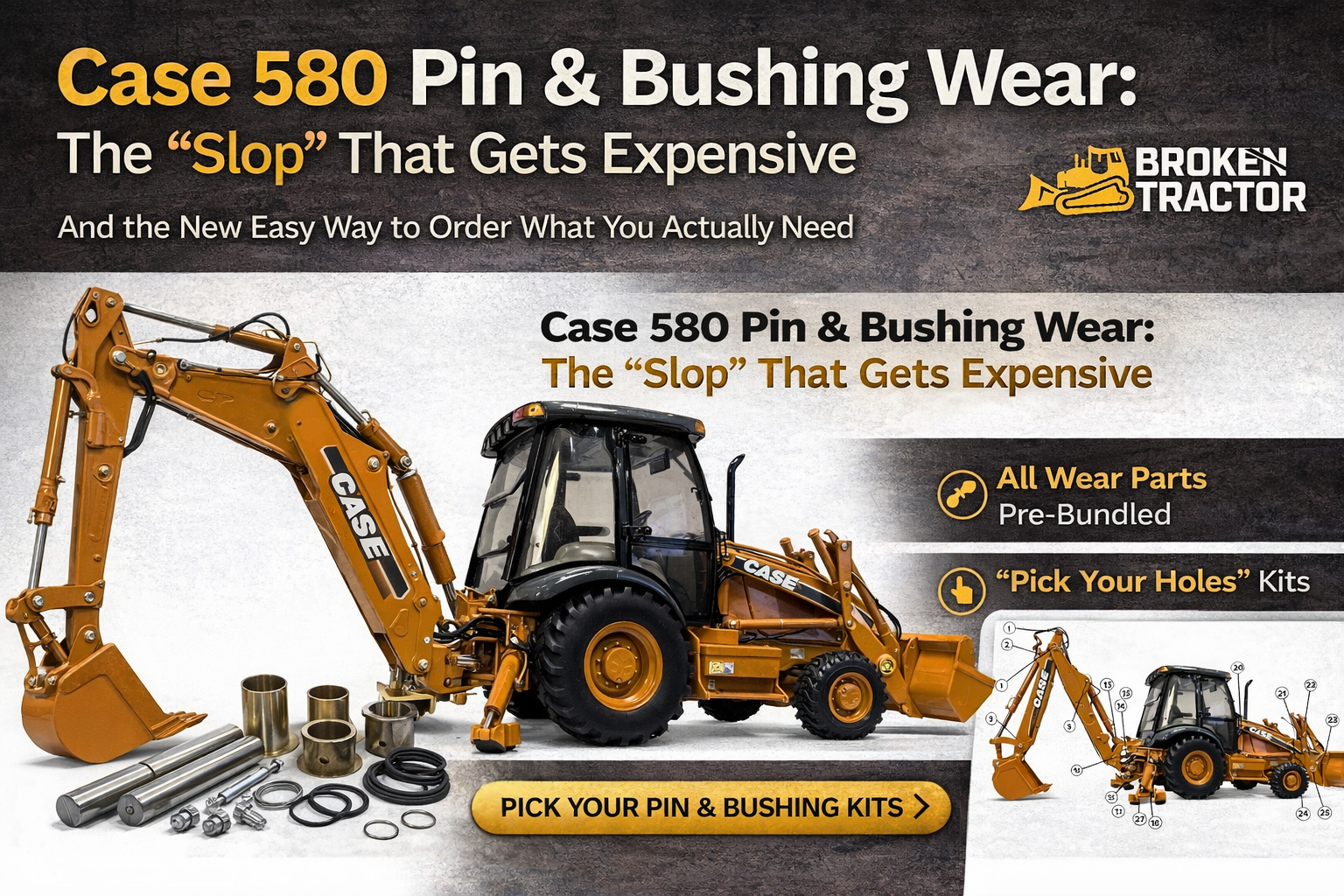
Case 580 Pin & Bushing Wear: The “Slop” That Gets Expensive (and the New Easy Way to Order What You Actually Need)
Posted by Broken Tractor on Feb 18th 2026
If your Case 580 feels loose, clunky, or just “tired,” you’re not imagining it.
-
Pin and bushing wear is one of the most common issues on Case 580 and 590-series backhoes.
-
It sneaks up on you.
-
One day it’s a little play… then the bucket won’t grade clean, the swing feels sloppy, and you start hearing the kind of noises that make you turn the radio up.
Here’s what’s really happening, why it matters, and the new easiest way we’ve found to order what you need.
What pin & bushing wear looks like in the real world
Customers usually describe it like this:
-
“My bucket won’t hold a line anymore.”
-
“The boom and dipper feel sloppy.”
-
“Swing clunks when I change direction.”
-
“The stabilizers feel loose and shift.”
-
“It’s hard to trench clean—it keeps wandering.”
That “slop” isn’t just annoying — it multiplies stress on the surrounding parts.
-
The longer it goes, the more you risk wearing the holes themselves.
-
A normal repair can turn into a much bigger one.
Why it gets expensive if you ignore it
A worn pin/bushing joint doesn’t wear evenly. It starts as a little play, then becomes:
-
Faster wear (because the joint is no longer tight and aligned)
-
More shock load on cylinders and linkages
-
Messy greasing (grease doesn’t stay where it should)
-
Sloppy control and faster operator fatigue
In other words:
-
It’s cheaper to catch early than to wait until everything is egg-shaped.
The old way to order pin & bushing parts (and why it’s a pain)
Traditionally, most people had to order like this:
-
Find the pin
-
Find the bushings (maybe 2, maybe 4)
-
Find the washers
-
Find the snap rings
-
Find the grease zerk
-
Find spacers / bolts / nuts (depending on the joint)
Even when you do it right:
-
It’s a time sink.
-
One missed washer can stop the whole job.
The new way: “Pick Your Holes”
We built a simpler system because pin/bushing jobs are repetitive and predictable.
Instead of shopping for individual parts…
-
You pick the joint (“the hole”) you’re rebuilding.
-
The kit includes what’s typically replaced at the same time:
-
Pins
-
Bushings
-
Common wear/retaining pieces
-
That’s not marketing fluff — it’s literally how the kits are configured.
For example:
-
Some kits include:
-
Pin
-
Bushings
-
Snap rings
-
Washers
(like many backhoe linkage joints)
-
-
Others include:
-
Grease zerk
-
Center bushing
(where the joint calls for it)
-
-
Many call out exactly what we’re solving:
-
“Includes all wear parts for one pin hole.”
-
Result:
-
Fewer mistakes
-
Fewer back-and-forth shipments
-
Less downtime
Example: Case 580D “Pick Your Holes” page
Here’s the format (diagram + table) for a Case 580D — and we have corresponding pages for the other Case 580 and 590-series machines too:
https://www.brokentractor.com/c/case-580d-backhoe-pin-bushing-kits/
You’ll see:
-
Pivot points laid out clearly
-
Ability to choose exactly where the wear is:
-
Bucket end
-
Dipper-to-boom
-
Swing tower connections
-
Stabilizers
-
Loader linkage
-
If you’re browsing by series:
-
The hub lists the major Case backhoe families (580, 590, and more)
-
You can jump to the correct model group quickly
Why “Pick Your Holes” is the smartest way to rebuild a worn backhoe
-
You order once and get the usual wear parts together (not piecemeal).
-
You don’t miss the little stuff (snap rings, washers, zerks, etc.) that can stall a repair.
-
It’s easier to plan a full refresh:
-
Do the worst joints now
-
Do the next set later
-
Ordering stays repeatable and simple
-
A quick “start here” tip
If you’re not sure what’s worn, start with the joints that take the most punishment:
-
Bucket and linkage area
-
Dipper stick to boom
-
Swing tower / swing cylinder connections
-
Stabilizer pivots
-
Loader linkage pivots
These are also the spots where customers most often feel the machine getting sloppy first.
Bottom line
-
Pin and bushing wear is normal for hardworking Case 580/590 machines.
-
What’s not normal is wasting time ordering six separate items per joint.
With Pick Your Holes:
-
You pick the pivot point.
-
We bundle what you typically replace together.
-
You rebuild faster and get back to work.



