John Deere 450G Crawler Dozer: The Hydrostatic-Era 450
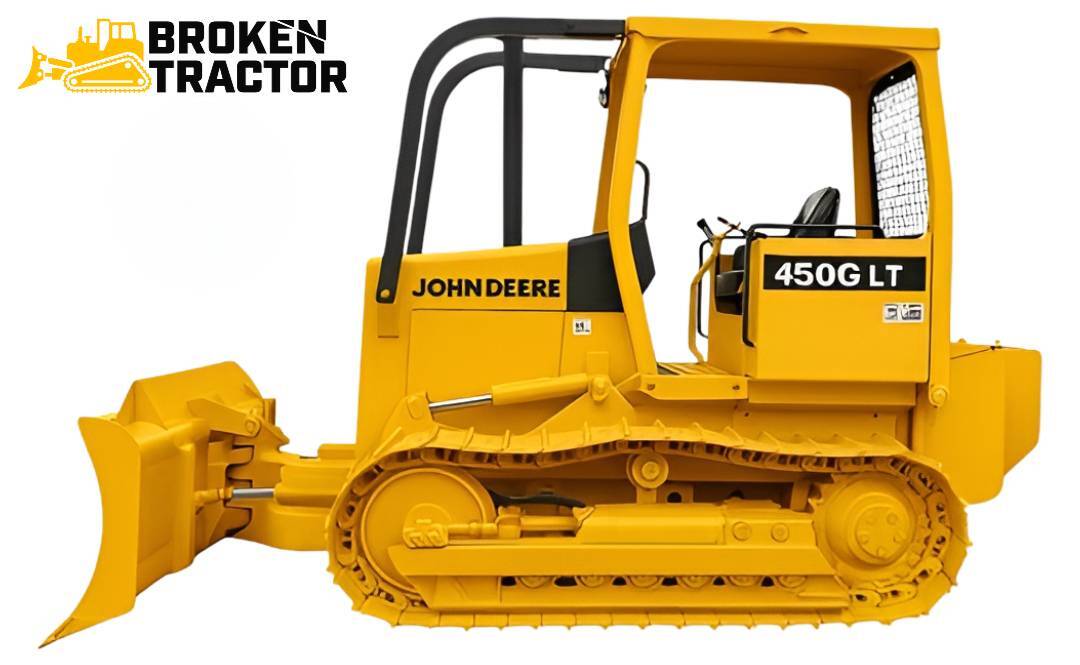
Launched in 1988 and produced into the mid-1990s, the 450G was the first 450 to ship with a hydrostatic dual-path drive system - a fundamental shift in how the mid-class JD crawler dozer worked. Counter-rotation, infinitely variable speed, and far less operator workload became standard on the 450 line.
Where the 450G fits in the JD crawler family
The 450G was a clean break from 23 years of mechanical-drive 450 design. From the original 450 in 1965 through the 450E in 1988, every 450 had used a mechanical transmission and steering clutches. The 450G replaced the entire drivetrain with a hydrostatic dual-path system: two independent hydrostatic pump-and-motor circuits, one per track, controlled by the operator with two T-bar levers.
The shift to hydrostatic put the 450 in line with the 455D / 455G crawler loaders, which had been hydrostatic for years, and brought modern operator workflow to JD’s mid-class dozer line. The 450G also received a redesigned operator station with improved cab options, refined visibility, and updated controls.
JD 450G Crawler Dozer - Quick Specs
- Production
- 1988 - Mid-1990s
- Class
- Mid-Size Crawler Dozer
- Engine
- JD 4-Cylinder Diesel
- Drivetrain
- Hydrostatic Dual-Path
- Steering
- Independent Track Control
- Predecessor
- JD 450E (Mechanical)
- Successor
- JD 450H
Why hydrostatic drive changed the 450
On a mechanical 450, every direction change required clutching the transmission, every steering input meant pulling a steering lever and feathering a brake. The 450G eliminated all of that. Hydrostatic dual-path lets the operator drive each track independently, in either direction, at any speed within the system’s range:
- Counter-rotation. Drive one track forward and the other in reverse to spin the machine in place. The mechanical 450 couldn’t do this.
- Infinitely variable speed. No gear changes - speed and direction are smoothly adjustable.
- Reduced operator fatigue. Far fewer control inputs per work cycle. Operators can run a 450G all day with less wear-and-tear on body and machine.
- No steering clutch service. The high-wear steering clutches that defined the mechanical 450 don’t exist on a 450G. Wear items shift to the hydrostatic pumps and motors.
The trade-off is more complex hydraulic service. A hydrostatic drive failure typically means a pump or motor rebuild - significantly more involved than adjusting steering clutches. But with clean cool hydraulic oil and on-schedule filter changes, hydrostatic 450s run reliably for many thousands of hours.
Engine, hydraulics, and undercarriage
The 450G ran a JD 4-cylinder diesel powering the dual-path drive system, the implement hydraulic circuit (blade lift, tilt, and angle), and the steering hydraulics. The undercarriage carried the proven JD-pattern sealed-and-lubricated track chain, planetary final drives, and JD-pattern rollers and idlers.
The implement hydraulic circuit on a 450G drives a 6-way blade on most configurations - power lift, power tilt, and power angle. Cylinder bore and stroke vary with blade configuration.
Common service items on the 450G
- Hydrostatic pumps and motors: Drive pump rebuilds, charge pump components, drive motor rebuilds, case drain hoses, filter housings.
- Hydraulic filtration: Suction strainers, return filters, charge filter, hydraulic oil. Critical on any hydrostatic machine.
- Undercarriage: Track chains, track shoes, rollers, idlers, sprockets, idler springs.
- Engine internals: JD 4-cylinder diesel rebuild kits - pistons, rings, sleeves, bearings, gaskets.
- Fuel system: Injection pump rebuilds, injectors, lift pump, fuel filters.
- Cooling system: Radiator, water pump, hydraulic oil cooler, thermostat, hoses.
- Implement hydraulics: Blade cylinders, seal kits, control valves, hoses.
- Final drives: Sprockets, planetary gears, seals, bearings.
- Electrical: Starter, alternator, harnesses, switches, gauges.
- Cab and operator station: Cab glass, weather seals, door parts, seat, A/C components on equipped machines.
Parts and cross-fit components for the John Deere 450G
| Category | Common Parts | Browse |
|---|---|---|
| Hydrostatic Drive | Drive pumps, motors, charge pumps, filters | Browse Hydrostatic Drive |
| Undercarriage | Track chains, shoes, rollers, idlers, sprockets | Browse Undercarriage |
| Engine | Pistons, rings, sleeves, bearings, gaskets | Browse Engine Parts |
| Fuel System | Injection pumps, injectors, lift pumps, filters | Browse Fuel System |
| Cooling | Radiators, oil coolers, water pumps, hoses | Browse Cooling Parts |
| Implement Hydraulics | Blade cylinders, seal kits, control valves, hoses | Browse Implement Hydraulics |
| Final Drives | Sprockets, planetary gears, seals, bearings | Browse Final Drives |
| Electrical | Starters, alternators, harnesses, switches | Browse Electrical |
| Operator Station | Seats, gauges, controls, cab glass, A/C parts | Browse Operator Station |
Need a part for your John Deere 450G Crawler Dozer?
Hydrostatic pumps and motors are the highest-value parts on a 450G. Call our parts team with your serial number for accurate identification.
Request a PartWhat to verify before ordering
- Serial number. The 450G had running changes through its production run. Match parts to the machine serial number.
- Hydrostatic pump/motor variant. Drive pump and motor part numbers changed during production. Confirm against the existing pump/motor casting numbers.
- Engine serial. JD 4-cylinder diesel internal parts must match the engine serial number.
- Undercarriage configuration. Standard, narrow, and LGP variants existed. Confirm shoe width and roller count.
- Blade configuration. 6-way, angle-only, and straight-blade configurations had different cylinder bore and stroke specs.
- Cab vs. ROPS canopy. Operator station equipment varied - confirm cab glass, A/C parts, and door parts to the right configuration.
Why the 450G is a productive used machine today
The 450G is the first JD 450 with the modern operator workflow customers expect from a current-production hydrostatic crawler dozer, but at a used-equipment price point. It runs a JD 4-cylinder diesel with no emissions aftertreatment (no DPF, no SCR, no DEF), a hydrostatic drive system that’s well-understood by service techs, and the proven JD undercarriage carried over from earlier 450 generations.
For customers running a 450G, maintenance priorities are clear: keep hydraulic oil clean and cool, change filters on schedule, replace undercarriage as it wears, and rebuild the engine on a sensible interval. Hydrostatic pumps and motors have long service lives when fed clean oil. Broken Tractor maintains parts coverage across the full 450 family.