
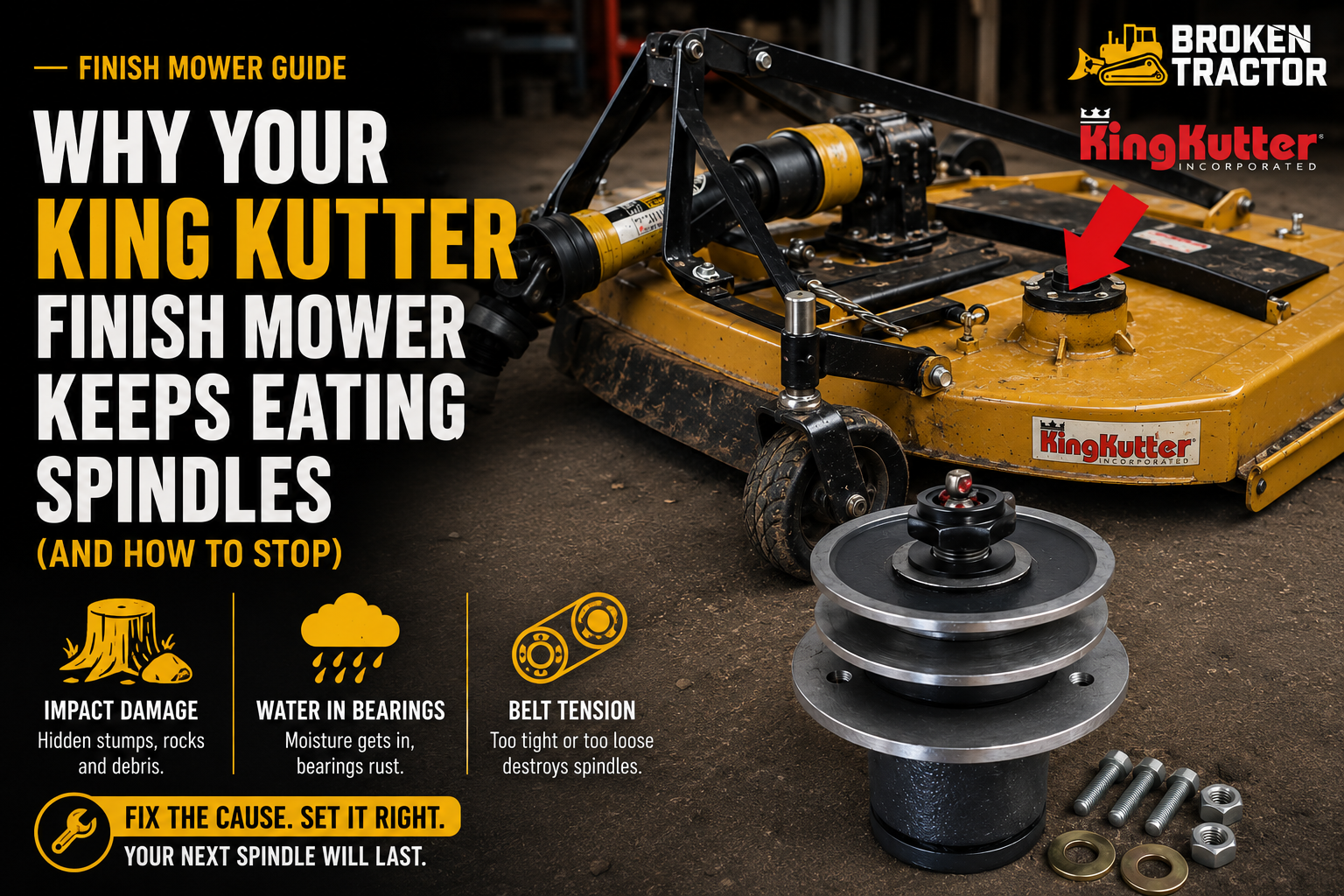
Why Your King Kutter Finish Mower Keeps Eating Spindles (and How to Stop)
Posted by Broken Tractor on May 19th 2026
Spindle failure is the most common repair on a King Kutter finish mower, and it almost always traces back to one of three things — one of which is the belt. Here's how to diagnose it, when to rebuild versus replace, and the belt tension that makes the next spindle last. If you've replaced a blade spindle on your King Kutter finish mower in the last year — or worse, more than one — you're not alone. Spindles are the highest-failure component on this implement, and the reason most operators are back ordering parts every season is that they replaced the spindle without fixing what killed the first one. Three things kill King Kutter spindles. Impact damage, water in the bearings, and belt tension that's wrong in either direction. Get all three under control and a fresh spindle will run for years. A failing spindle telegraphs itself before it lets go entirely. Watch for: Catch it at the growling stage and you save a belt. Catch it at the visible-vibration stage and you're already shopping for the spindle. The most common cause, and the hardest to prevent. A stump, a rock, a piece of wire, a fence post buried in the grass — anything the blade hits at full PTO speed transfers shock straight up the blade bolt into the spindle shaft. The shaft bends a few thousandths, the bearings start running out of true, and the spindle is on the clock. Sometimes the failure is immediate; more often it shows up two or three uses later. You can't always avoid hidden obstacles, but you can scout new areas at walking pace before you mow them at speed, and you can leave the brush hog (rotary cutter) on for unimproved ground and use the finish mower only on areas you've already cleared. Finish mowers live outside, often uncovered. The spindle housing sits horizontally on top of the deck with the pulley exposed to weather. Rain finds its way past the upper seal and pools in the housing, and over a winter of freeze-thaw cycles the bearings rust internally. Come spring, the spindle that worked fine in October is grinding by the second pass. If your mower stores outside, the cheapest preventive measure is making sure the lower spindle cap (191302) is in place and not cracked. It's a $43 part that keeps water out of the bottom of the housing — the side most operators never check. This is the one most operators don't connect to spindle wear, and it's the one that turns a spindle replacement into a recurring repair. Too tight and the belt loads the spindle shaft sideways with constant tension — more than the bearings are designed to carry. The shaft deflects a few thousandths under load, the bearings wear on one side, and the spindle dies in a fraction of its normal life. A belt cranked tight to "stop the slipping" is killing both spindles at once. Too loose and the belt slips at every PTO engagement, which shock-loads the spindle the moment it bites. Belts that flop and pop create the same impact-damage pattern as hitting a stump — small jolts repeated thousands of times per acre. Once a spindle has bearing damage, you have two options. The Spindle Bearing Kit (555009) at $52 fits the 502301, 502303, and 502304 spindle units and includes upper and lower bearings, seals, and snap rings. If the spindle shaft is straight and the housing is undamaged, this is the cost-effective fix. The catch: rebuilding requires pulling the spindle, pressing the old bearings out cleanly, and pressing new bearings in straight. Without a press and the right pilot, it's easy to cock the bearing on the way in and ruin a $52 kit on the install. And if the shaft has bent from impact damage, the new bearings will fail just as fast as the old ones. The Spindle Assembly (502303 single groove / 502304 double groove) at $105 ships complete with the housing, shaft, pulley, bearings, seals, and all mounting hardware including the blade bolt. You bolt it on and you're done. No press, no pilot, no risk of contaminating new bearings during install. For most operators, the assembly is the better buy. The $53 you save with the bearing kit disappears the first time the rebuild doesn't go cleanly or the bent shaft sends the new bearings out in a hundred hours. Replace the spindle, and you know what you have. If you're under the deck pulling the spindle, the belt comes off anyway. Put a fresh one back on. A belt that's been running on a worn spindle has uneven wear patterns on its inside surface; reusing it on the new spindle accelerates wear and can trick you into thinking the new spindle is bad when the belt is what's actually slipping. While you're in there, check the idler pulley (164090 single / 164091 double). The idler bearing is just as exposed to weather as the spindle bearing, and a sticking idler is the second most common cause of belts that "won't stay tight." Spindle assemblies, bearing rebuild kits, belts (standard and Kevlar), idler pulleys, tension springs, and blade kits — all in stock with U.S. warehouse shipping. Official King Kutter parts dealer since 2006.Why Your King Kutter Finish Mower Keeps Eating Spindles (and How to Stop)
How to know it's the spindle
The three things that actually kill them
1. Impact damage from hidden obstacles
2. Water in the bearings
3. Belt tension that's wrong in either direction
Rebuild or replace the spindle?
Option A — Bearing rebuild kit (cheaper)
Option B — Complete spindle assembly (recommended)
Spindle assembly fitment
Replace the belt at the same time
Belt
Use case
Sizes
Standard single groove belt
OEM-spec replacement for normal residential and small acreage use
4', 5', 6', 7', and RFM-48-XB
Heavy-duty Kevlar belt
Higher load capacity, longer life, better resistance to wear from minor pulley misalignment
4', 5', 6', and RFM-48-XB
Double groove belt
For mowers running double-groove spindle and idler pulleys
6' and 7'
The reset: getting it right after a spindle replacement
Need King Kutter finish mower parts?