How We Improved BrokenTractor.com for Real-World Parts Buyers (Not “Chronically Online” Shoppers)
Posted by Broken Tractor on Feb 17th 2026
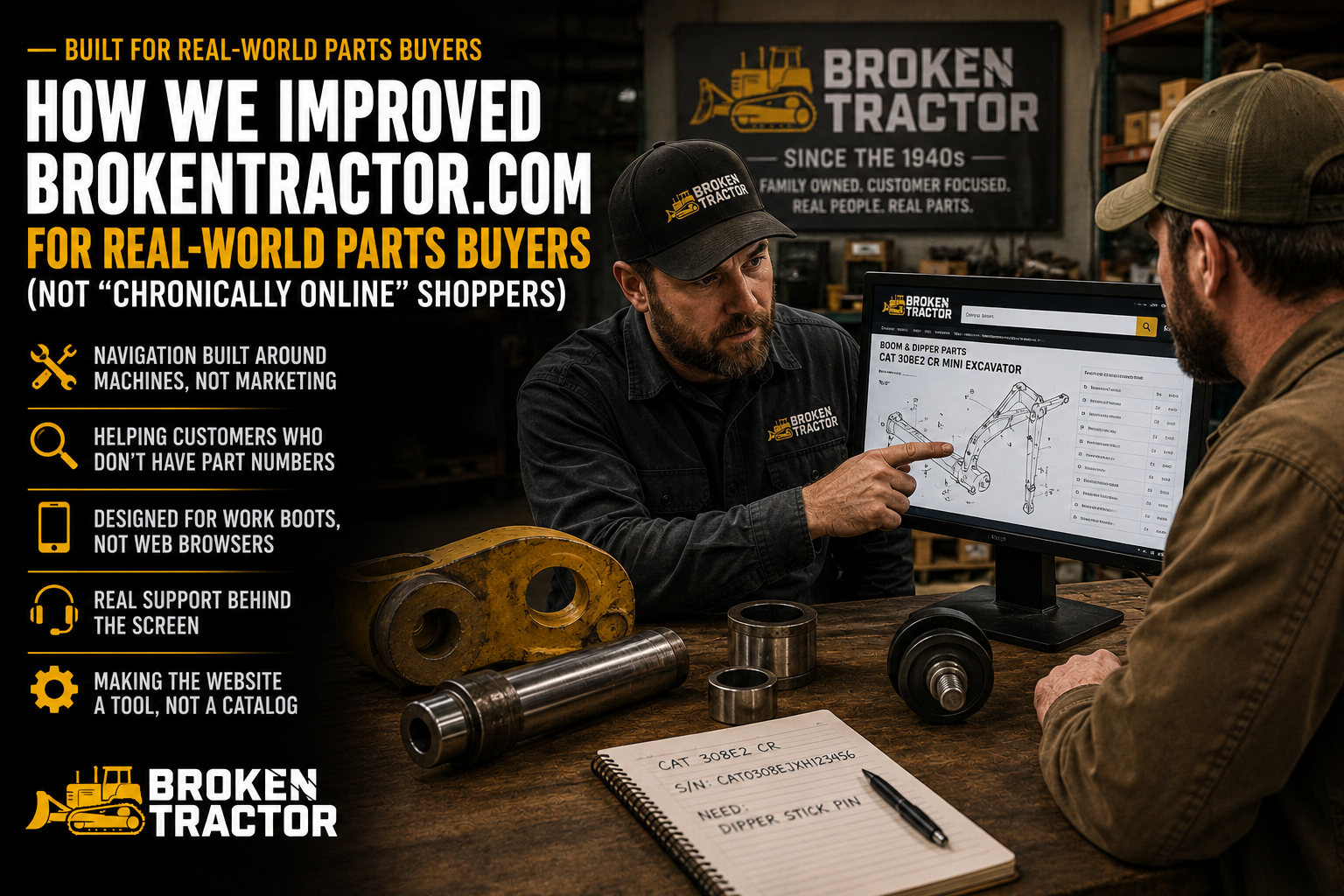
A family parts business since the 1940s. A website redesigned over the last few years by watching real customers struggle to find what they came for. Here's what we changed, why we changed it, and what we still get wrong. The first phone call we got this morning came from a contractor in West Virginia at 7:14 AM Eastern. His 580 Super L wouldn't move forward. He'd been on the phone with his dealer the day before — three-week lead time on the part — and somebody on a forum had told him to call us. That call is what BrokenTractor.com is for. Our family has been in the parts and salvage business for over 50 years. Broken Tractor LLC turns 20 this year — we started in 2006, in a yard in Baton Rouge, with the same phone number we still answer today. The website you're reading this on came later. And over the last few years, we've redesigned it from the ground up with one goal: make it feel less like an online store and more like a tool for finding parts. Here's what we changed and why. For a while, we suspected our site had problems. Customers were finding it, landing on pages, and leaving without ordering. We knew this because the analytics said so. We didn't know why until we installed Lucky Orange and started watching session recordings. Watching someone try to use a website you built is humbling. We saw customers land on our Case backhoe information page — a page our team was proud of — and just sit there. They'd scroll. They'd hover. They'd leave. We thought we were giving them useful information. They were looking for a way to get to the parts. The fix was small: add prominent links from the information pages to the specific parts categories. That single change — links our team had assumed weren't needed — completely changed how customers used those pages. People stopped getting stranded. We thought customers were reading our technical specs and descriptions. Heatmap data said they weren't — they were studying the photos. That changed how we work. Every new part we list now gets photographed against a clean background with multiple angles. When customers send us a photo of a worn part and ask "is this the same one you have," we know exactly which images we need to verify their fitment. The customer who can't read a 17-character part number can usually tell us "yeah, that's the one" from a picture. Before we had real data, our homepage was organized the way we wanted it to be — by what we thought was important. Heatmaps showed us what was actually important to our customers, and it wasn't always the same thing. The big surprise: John Deere parts traffic was much higher than our placement implied. We'd built the company on Case backhoe parts, so Case got the prime real estate. The data said we should give John Deere equal prominence. We did. Engagement went up. We reorganized the rest of the homepage around the same principle — high-demand, in-stock products at the top, deeper category navigation accessible but not in the way. The site is faster to use now because the things most customers need are where they expect to find them. Heavy equipment parts buying has a trust problem. We're not the only website selling a Case 580 hydraulic pump online, and the customer landing on our page often has no idea who we are or whether the part will actually fit. The forums vouch for us when our name comes up, but most customers don't read forums before they buy. So we added Yotpo to collect and display customer reviews on product pages. The reviews speak for the parts — and for the company — in a way our marketing copy can't. When a contractor in Kansas reads that another contractor in Georgia ordered the same pump and it dropped right in, that's a different kind of confidence than reading "OEM quality" on a product description. We also launched a loyalty program through Smile.io because real-world parts buyers come back. Not the way fashion shoppers come back — they come back when the next thing on the machine wears out. A loyalty program that rewards that pattern made sense for our customer in a way it doesn't for most e-commerce. When a hydraulic cylinder fails, the operator isn't thinking "I need to browse the Hydraulics category." They're thinking "I need a seal kit for a 580 Super M dipper cylinder." So we rebuilt the category structure to match that mental model. Not by component family — by machine and part group. Case Backhoe Hydraulic Cylinder Seal Kits is its own category. Then a sub-category for the specific series — 580L/580M, 580 Super L/580 Super M, 580K/Super K, 580C/580D/580E. Same logic across John Deere backhoe reverser transmission parts, Case backhoe hydraulic pumps, every line that customers come to us for. It looks like over-organization until you watch a customer use it. Then it looks obvious. The biggest difference between Broken Tractor and most online parts sites isn't what's on the site — it's what's behind it. When a customer calls (800) 909-7060, somebody on our team picks up. Not a phone tree. Not a chatbot. A person in Baton Rouge or Kimbolton, Ohio, who can pull up a parts diagram and help. That matters because a lot of our customers can't find what they need by browsing. They have a worn-off serial number plate, a part they pulled off a machine they inherited, or a description that doesn't match anything in any catalog. We get sourced parts from our salvage network, from manufacturer relationships built over decades, and sometimes from machines sitting in our own yards. Those parts don't show up in a search index. They show up because a person on our team picked up the phone. The site is better than it was three years ago. It is not perfect. We still have product pages with photos that need updating. We still have categories where the part you're looking for is technically there but hard to find. Our search is faster than it used to be but it isn't always smart about model variations. We're working on all of it. Every month another section gets attention. If you find something that doesn't work — a broken link, a confusing category, a product page that's missing information — we want to know. Email parts@brokentractor.com and tell us. That's how the site got better in the first place. Real customers told us what was broken. BrokenTractor.com is built for people who need a part to get a machine working again. The redesign is ongoing, the family business is still family-run, and the phone number on the homepage is still answered by people whose job is finding parts. If the site helps you find what you need, great. If it doesn't, call us — that's why we exist. Send us your machine make, model, and serial number. Add a photo of what you're replacing if you have one. We'll work it.How We Rebuilt BrokenTractor.com for People Who Need a Part, Not a Shopping Experience
We watched real customers struggle, then fixed what broke
The pictures matter more than the words
The homepage reorganized around what people actually click
We added reviews because customers asked for them
The categories had to match how people actually break down
The phone is still the most important part of the website
What we still get wrong
The bottom line
Need help finding a part?